
A one-evening family checklist for the dark trip from bed to bathroom: walk the route together, light it end to end, clear the floor, add grip where it gets wet, and know when to call the doctor or an OT.
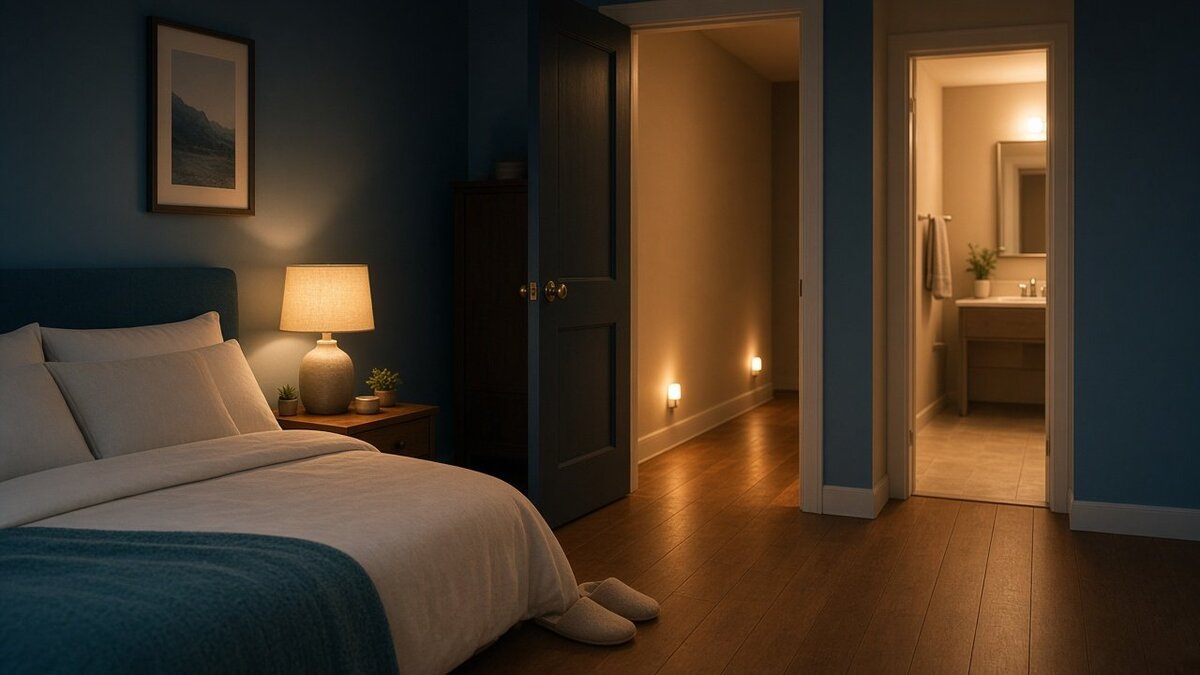
A one-evening (or Saturday-morning) plan for adult children who want to make a parent's trip from bed to the bathroom safer after dark: what to look for, what to plug in, what to stick down, and what to leave for a doctor or therapist.
Educational information only. This guide is not medical, therapy, or electrical advice. Every person and every home is different. If your parent has fallen recently, feels dizzy when they stand, or has new trouble walking, talk with their doctor before relying on a checklist, and ask about a home safety visit from an occupational or physical therapist.
Some links on this page are affiliate links, marked "affiliate link." If you buy through them, YouRetire may earn a commission at no extra cost to you. It doesn't change what we recommend. See our editorial standards.
Why the night trip deserves its own plan
Most home safety checklists walk room by room. This one follows a single route: the twenty or thirty steps your parent takes from the edge of the bed, through the bedroom door, down the hallway, and into the bathroom, usually half-awake, often in the dark, and sometimes in a hurry.
That route stacks several fall risks into a few minutes:
- Getting up. Standing straight up out of a warm bed can leave some people lightheaded. The National Institute on Aging (NIA) notes that getting up too quickly can cause blood pressure to drop and make a person feel wobbly.
- Seeing in the dark. The National Eye Institute lists needing more light to see well, and needing more time to adjust to changing levels of light, among the normal vision changes that come with age. A hallway that looks "dim but fine" to you can be much harder for your parent to read at 3 a.m.
- Walking on whatever is on the floor. Slippers, a dropped towel, a pet asleep in the doorway, a phone charger cord, or a rug that slides.
- Arriving at a wet floor. MedlinePlus, from the National Library of Medicine, calls the bathroom the place in the home where falls most often happen. Water on tile at the tub edge or by the sink is a different surface than the hallway carpet a few steps earlier.
Falls themselves are common. According to the CDC, more than one in four adults age 65 and older falls each year, but less than half tell their doctor. You can't change your parent's eyesight or blood pressure over a weekend. You often can change the light, the floor, and the footing along this one path, and those are the parts this checklist covers.
Want the bigger picture? Our Senior Home Safety and Fall Prevention Checklist covers the whole house, and Bathroom and Bedroom Safety Upgrades is a short list of quick fixes. For grab bars, shower seats, and toilet support, see our full Bathroom Fall Prevention for Aging Parents checklist. This guide zooms in on the dark path and the wet floor at the end of it.
What this project is (and isn't)
This is a small, practical project. Most families can finish it in one evening walkthrough plus a Saturday morning of plugging in, clearing, and sticking down.
It is:
- A walkthrough of one route, done with your parent, after dark
- Lighting that turns the route on without anyone hunting for a switch
- A clear floor from bed to toilet
- Better grip where the floor gets wet
- A few habits: sitting before standing, slippers by the bed, a phone within reach
It isn't:
- A bathroom remodel. If the walkthrough shows your parent needs grab bars, a shower seat, or a raised toilet seat, our bathroom fall prevention checklist walks through those step by step.
- A medical fix. Night-time dizziness, urgency, new confusion, or a recent fall belong with a doctor (more on that below).
- A promise. No light or sticker can guarantee your parent won't fall. The aim is fewer surprises along a route they walk every night.
Step 1: Walk the path with your parent after dark

The most useful thing you can do costs nothing: walk the route with your parent once, at night, with the lights the way they normally leave them.
Pick an evening when your parent is rested and not rushed. Frame it as making the house easier at night, not as "you might fall." Many parents are more open to "I want to see where the light switches are" than to "let's talk about your balance."
How to do it
- Turn off the lights the way your parent normally does before bed.
- Have your parent lie down, then get up and walk to the bathroom the way they usually would. Walk beside or slightly behind them. Don't narrate; watch.
- Then do it yourself, slowly, and pay attention to where your eyes struggle.
- Take notes and a few phone photos (no flash, so you see what the dark really looks like). A rough sketch of the route with an X at each problem spot is enough.
What to watch for
- The first ten seconds. Does your parent sit on the edge of the bed for a moment, or stand straight up? Do they reach for a lamp, a phone light, or nothing?
- Grab points. Every time they touch a dresser, door frame, wall, or towel bar for balance, note it. Those are the spots where light or support matters most.
- Dark gaps. Where on the route does it go from "I can see the floor" to "I'm guessing"? Doorways and the turn into the bathroom are common gaps.
- Floor surprises. Rugs, runners, bath mats, cords, shoes, laundry, pet beds or bowls, and thresholds between carpet and tile.
- Footwear. What are they wearing? Socks only, backless slippers, or nothing are all worth noticing.
- The bathroom arrival. Is there light before they step onto the bathroom floor? Is the floor dry? Where do they put their hand as they turn to sit on the toilet?
Then ask a few short questions:
- How many times do you usually get up at night?
- Have you ever stumbled, slipped, or felt dizzy on the way to the bathroom, even if you didn't fall?
- Do you ever turn on the big overhead light? Is it too bright when you do?
- Is there anything you'd change about this walk?
Reading what you saw
| What you noticed | What it may point to | What to try first |
|---|---|---|
| Stands straight up from bed and pauses or sways | Possible lightheadedness when standing | Sit-then-stand habit; mention it to the doctor |
| Hunts for a switch or uses a phone light | No light reachable from bed | Lamp or touch light within reach; motion night light by the bed |
| Slows down or reaches out in the hallway | A dark gap along the route | Plug-in night lights so the route stays lit end to end |
| Feet catch on a rug edge or threshold | Trip hazard on the floor | Remove the rug or secure it; mark or light the threshold |
| Steps around a pet, laundry, or cords | Clutter in the walking path | Clear a dedicated route; move cords along the wall |
| Grabs a towel bar, sink edge, or door to turn or sit | Missing support in the bathroom | See the bathroom fall checklist for grab bars and an OT visit |
| Wet floor at the tub edge or by the sink | Slippery landing zone | Non-slip treads in the tub; mat that stays put; dry the floor |
Keep the list short. Most families find three to six things to fix, not thirty.
Step 2: The bedroom launch zone

The first steps out of bed set up the rest of the trip. The goal: your parent can see before they stand, can stand without hurrying, and has their feet in safe footwear before they walk.
Light before feet hit the floor
- ☐ A lamp or light your parent can reach without getting up. The CDC's Check for Safety home checklist says to place a lamp close to the bed where it's easy to reach. NIA recommends night lights and light switches close to the bed. A lamp with a large switch or touch base is easier to find half-asleep than a small knob.
- ☐ A night light near the bed. A low, steady light (or one that turns on with motion) means the floor next to the bed is visible the moment your parent sits up.
- ☐ A flashlight on the nightstand. NIA suggests keeping one by the bed in case the power goes out. Check the batteries while you're there.
Getting up without rushing
- ☐ Practice the sit-then-stand habit. Sit on the edge of the bed for a moment, feet flat, before standing. NIA notes that standing up too quickly can make blood pressure drop. If your parent often feels dizzy or lightheaded when they stand, tell the doctor.
- ☐ Check the bed height. If your parent's feet don't rest flat on the floor while sitting on the edge, or if standing up takes a big push, mention it to their doctor or an OT. Don't change bed height or add bed equipment on your own; a therapist can suggest what fits.
- ☐ Something steady to hold. A sturdy nightstand or dresser near the bed can help. Wobbly furniture or a lamp table on casters is not a handhold.
Feet and phone
- ☐ Safe slippers parked by the bed. NIA advises against walking on floors in socks or in smooth-soled shoes or slippers. The CDC's footwear fact sheet describes a safer shoe as one with a firm heel collar, a low, broad heel, a textured sole, and laces or straps that hold it on, and advises against backless styles. Set aside slippers that are backless, stretched out, or worn smooth, and put a closed-back, non-slip pair where your parent's feet land.
- ☐ A charged phone within reach of the bed. NIA suggests a well-charged phone near the bed. If your parent lives alone, a way to call for help from the floor matters even more. Our medical alert checklist for seniors living alone explains the options and the questions to ask.
- ☐ Glasses where they can be found. If your parent wears glasses to walk around, keep them in the same spot on the nightstand every night.
Clear the floor around the bed
- ☐ Nothing on the floor on the side of the bed your parent gets out of: no shoes (except the slippers), books, bags, or laundry.
- ☐ Bedspreads and blankets that don't trail onto the floor.
- ☐ Cords from lamps, phone chargers, or heating pads routed behind the nightstand and along the wall, not across the path. NIA suggests keeping electrical and phone cords along walls and out of walking paths.
Step 3: The hallway and doorways
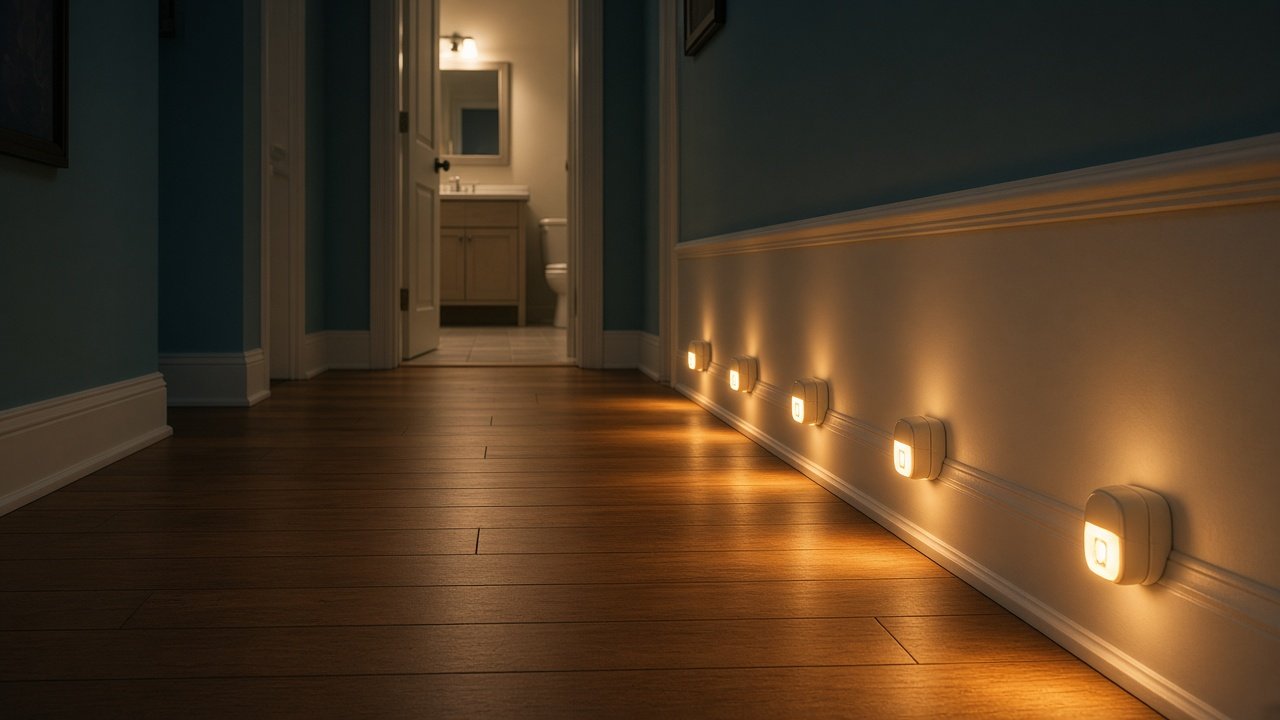
The hallway is where many night routes go dark. The bedroom has a lamp, the bathroom has a light, and the twelve feet between them has nothing.
Make the light continuous
- ☐ No dark gaps. Stand at the bedroom door at night and look toward the bathroom. You should be able to see the floor all the way there. The CDC suggests a night light if the path from the bed to the bathroom is dark, noting that some turn on by themselves after dark. NIA suggests plug-in motion-activated lights for pathways.
- ☐ Light the turns and doorways. The spots where your parent changes direction, crosses a threshold, or steps through a door deserve their own light.
- ☐ Avoid glare. Very bright lights pointed at eye level can be as hard to walk toward as darkness. Low, outlet-level night lights that light the floor are usually easier on eyes that have just opened.
- ☐ Keep it automatic. A light that has to be remembered, found, and switched on in the dark tends not to get used. Motion-sensor or dusk-to-dawn night lights don't depend on your parent remembering.
Clear the floor
- ☐ Loose runners and throw rugs. NIA advises against throw rugs and small area rugs. The CDC suggests removing small rugs or using double-sided tape so they won't slip. If your parent wants to keep a runner, make sure it lies completely flat, has no curled edges, and doesn't slide when you push it with your foot.
- ☐ Thresholds. A raised strip between carpet and tile is easy to catch with a toe in the dark. Make sure it's lit. If it's loose or very raised, a handyperson can often fix or replace it.
- ☐ Furniture and storage. Move side tables, laundry baskets, plant stands, and boxes out of the walking line, not just to the edge.
- ☐ Pets. If a dog or cat sleeps in the hallway or follows your parent at night, think about where pet beds, bowls, and toys sit. A water bowl by the bathroom door is a wet-floor hazard twice over.
Something to hold
- ☐ Notice where your parent touches the wall. If they steady themselves along the hallway, ask their doctor or an OT whether a hallway handrail or grab bar would help. Wall-mounted support needs to be anchored properly; a towel bar or a decorative shelf is not a handrail.
- ☐ Doors. Doors that swing into the path or close halfway can be bumped in the dark. Prop them fully open at night or adjust them so they stay open.
Lighting the whole route: how to place night lights
Once you've seen the route at night, plan the lights as a line, not one at a time. A simple approach:
- One by the bed (low outlet near the nightstand, on the side your parent gets out).
- One at the bedroom door, so the doorway and threshold are visible.
- One or more along the hallway, spaced so the next pool of light starts where the last one fades. Long or L-shaped hallways may need more than one.
- One at the bathroom door or just inside, near the vanity or toilet, so your parent can see the floor before stepping onto it. NIA suggests leaving a light on in the bathroom at night or using a night light that turns on automatically.
Placement tips
- Use outlets low on the wall so light falls on the floor, not into your parent's eyes.
- Check that a night light doesn't block an outlet your parent uses every day, or get kicked by a door.
- Test at night, after the lights have been off for a while. What looks fine at dusk can be too dim at 2 a.m.
- If the route crosses a staircase, NIA recommends light switches at both the top and bottom of stairs. Stairs are outside the scope of this checklist; our home safety checklist covers them.
- Plug-in lights are a DIY job. New hardwired switches, outlets, or fixtures are a job for a licensed electrician.
If you need plug-in night lights: a two-pack of plug-in motion-sensor night lights can cover the bed and the bedroom door, with more added for a longer hallway. One example is this GE motion-sensor plug-in night light two-pack on Amazon (affiliate link). Whatever you choose, check the brightness and motion settings at night along the actual route.
Step 4: The bathroom doorway and the wet zone
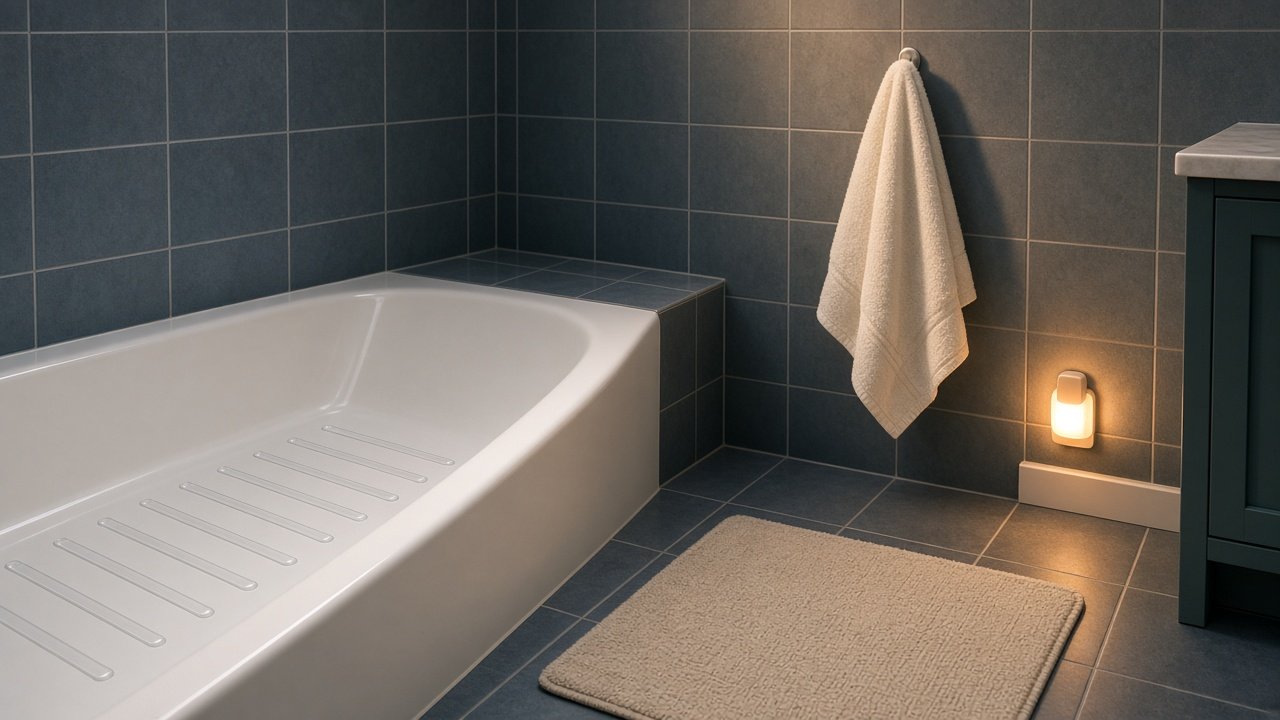
The last few steps of the route are often the slipperiest. Your parent comes from carpet or wood onto tile, sometimes onto a floor that's still damp from an evening shower, and then has to turn and sit.
Arriving in the bathroom
- ☐ Light before the step in. A night light near the bathroom door or vanity means your parent can see the floor before they step onto it. If they reach in to find a switch, make sure the switch is right at the door and easy to find.
- ☐ A clear, short path to the toilet. Nothing on the floor between the door and the toilet: no scale, laundry basket, trash can in the line, or step stool.
- ☐ Watch the turn. Note what your parent grabs as they turn to sit. If it's a towel bar, the sink edge, or the toilet paper holder, MedlinePlus is clear that towel racks can't support a person's weight. That's a sign to read the grab bar section of our bathroom fall prevention checklist and to ask about an OT visit.
The wet zone: tub, shower, and the floor around them
- ☐ Grip on the tub or shower floor. The CDC's Check for Safety checklist suggests a non-slip rubber mat or self-stick strips on the floor of the tub or shower. MedlinePlus suggests non-slip suction mats or rubber silicone decals in the bottom of the tub. Adhesive treads stay in place and don't need to be lifted out to dry; follow the package directions for cleaning and drying the surface first, and check which surfaces they're made for.
- ☐ A mat outside the tub that doesn't slide. MedlinePlus suggests a non-skid bath mat outside the tub for firm footing. Push it with your foot: if it moves, curls, or bunches, replace it or remove it. NIA advises against small rugs that can slip.
- ☐ Keep the floor dry. MedlinePlus advises keeping the floor outside the tub or shower dry. Wipe up after evening showers so the floor is dry before bedtime. A small towel or squeegee kept in the bathroom makes this a habit.
- ☐ Towel and robe within seated reach. If your parent dries off sitting down, the towel should be reachable from that seat, not across a wet floor.
- ☐ Non-slip surfaces where the floor gets wet. NIA suggests nonskid strips or mats on all surfaces that may get wet, including next to the tub, toilet, and sink if the floor isn't carpeted.
- ☐ Water temperature. MedlinePlus and NIA suggest setting the water heater no higher than 120°F (49°C) to prevent burns. It's a quick check while you're in the bathroom.
If the tub or shower floor needs grip: self-stick tread strips are a short DIY job. One example is this SlipX 12-strip non-slip bathtub tread set on Amazon (affiliate link). Clean and dry the tub well before applying, give the adhesive the time the package says before anyone showers, and check the edges now and then for lifting.
If the walkthrough shows bigger bathroom gaps
Sometimes the night walk shows more than a lighting problem. Your parent grabs the towel bar every time they sit, steadies themselves on the shower door, or tells you they've started skipping showers because getting in and out feels risky.
Those are signs the bathroom itself needs support, not just better light. The usual next steps are:
- Grab bars anchored into studs or with the right anchors for the wall, placed where your parent actually reaches. MedlinePlus notes grab bars should be mounted vertically or horizontally, not diagonally, and that most people need two: one for getting in and out of the tub, one for standing up from sitting.
- A shower chair, stool, or transfer bench so your parent can wash sitting down.
- A raised toilet seat or toilet safety frame if standing up from the toilet takes a big push.
- An occupational therapist's home visit. MedlinePlus suggests asking the doctor for a referral to an occupational or physical therapist, who can visit the bathroom and make safety recommendations.
Our Bathroom Fall Prevention for Aging Parents checklist covers each of these zone by zone, including where grab bars usually go and what to leave to a licensed installer.
If you're ready to shop for bathroom aids: Vive Health's bathroom safety collection (affiliate link) groups grab bars, shower chairs, and toilet aids in one place. Ask your parent's OT or doctor which type fits before you buy, and read our bathroom checklist for installation and anchoring detail.
Buy and place checklist
Use this as your shopping and setup list. Everything marked DIY can usually be done in an afternoon; anything that goes into the wall, wiring, or plumbing is a job for a pro.
| Item | Where on the route | DIY or pro | Notes |
|---|---|---|---|
| Bedside lamp or touch light | Nightstand | DIY | Reachable without standing; large switch or touch base |
| Plug-in motion night light | Low outlet by the bed | DIY | Lights the floor where feet land first |
| Plug-in motion night lights | Bedroom door, hallway, turns | DIY | Space so there are no dark gaps; test at night |
| Night light or left-on light | Bathroom door or vanity | DIY | Floor visible before stepping in |
| Flashlight | Nightstand | DIY | For power outages; check batteries |
| Closed-back, non-slip slippers | Parked by the bed | DIY | Firm heel collar, textured sole; retire worn pairs |
| Charged phone or alert button | Within reach of the bed | DIY | Charger cord routed along the wall |
| Remove or secure rugs and runners | Bedroom, hallway, bathroom | DIY | Remove, or double-sided tape so they won't slide |
| Cord clean-up | Bedroom and hallway | DIY | Along walls, out of the walking line |
| Non-slip tub or shower treads | Tub or shower floor | DIY | Clean and dry surface first; follow package cure time |
| Non-skid bath mat | Outside the tub or shower | DIY | Should not slide, curl, or bunch |
| Towel or robe hook at seated reach | Next to the shower | DIY or handyperson | Reachable without crossing a wet floor |
| Grab bars | Toilet, tub, shower entry | Pro (or very experienced DIY) | Anchored properly; ask an OT where they go |
| Hallway handrail | Along a long hallway | Pro | Only if your parent steadies on the wall; ask an OT |
| New switches, outlets, or hardwired lights | Anywhere on the route | Licensed electrician | Not a DIY job |
| Threshold repair | Doorways | Handyperson | Loose or very raised strips |
A one-evening plan (plus Saturday morning)
You don't need a full weekend. Here's a realistic way to split it.
| When | What to do | Time |
|---|---|---|
| Evening, after dark | Walk the route together; note grab points, dark gaps, floor hazards; take photos | 20–30 minutes |
| Same evening | Talk through what you saw; agree on two or three changes your parent is comfortable with | 15 minutes |
| Before Saturday | Order or pick up night lights, treads, a non-skid mat, slippers if needed | — |
| Saturday morning | Clear the floor; move cords; remove or secure rugs; set up the nightstand | 1 hour |
| Saturday morning | Plug in night lights; clean, dry, and apply tub treads | 1 hour plus adhesive cure time |
| Saturday night | Test the route again in the dark; adjust light placement | 15 minutes |
| A week later | Ask how the nights are going; check treads and mats; replace dead bulbs or batteries | 10 minutes |
If you live far away, you can do the walkthrough over a video call: ask your parent (or a neighbor or sibling) to walk the route with the phone camera pointed at the floor. You'll see more than you'd expect.
Talking with your parent about the night route
Night-time bathroom trips can feel private. Some parents would rather not talk about how often they get up or what happens on the way. A few approaches that tend to go better:
- Start with the house, not the person. "This hallway is really dark at night" lands better than "I'm worried you'll fall."
- Let them choose. Offer two options ("a lamp with a touch base or a motion light by the bed?") rather than a list of orders.
- Keep it small. A couple of night lights and a pair of good slippers can build trust for bigger changes later.
- Ask what they've noticed. Your parent may already know where the worst spot is.
- Respect the "no." If your parent doesn't want something, ask why. "The light keeps me awake" has a fix (a dimmer light, or a different spot). "I don't need it" may need a later conversation, or a word from their doctor.
What lights and stickers can't fix
A lit path and a grippy tub floor are good changes, but they don't address the reasons a person might be unsteady in the first place. Talk with your parent's doctor if any of these come up:
- Dizziness or lightheadedness when standing. NIA suggests asking to have blood pressure checked lying down and standing. The CDC's STEADI program has a short brochure on this kind of dizziness, called postural hypotension.
- Medicines. NIA notes that some medicines can raise fall risk by causing dizziness or confusion. The CDC lists medicines such as sedatives, tranquilizers, and antidepressants among fall risk factors, and notes that some over-the-counter medicines can affect balance, too. Sleep aids and medicines taken at bedtime are worth a specific question. Don't stop or change a medicine without talking to the prescriber; ask a doctor or pharmacist to review the whole list. Our guide to medication management for older adults can help you organize it.
- Getting up many times a night. Frequent night-time urination is worth mentioning to a doctor. There may be causes or timing changes (for medicines or fluids) the doctor can look at.
- Vision. If your parent struggles to see in dim light, an eye exam is a good idea. Our guide to vision changes and home safety has more.
- Strength and balance. The CDC lists lower body weakness and walking and balance problems among fall risk factors. A physical therapist can help; our guide to Medicare outpatient therapy after a fall explains how families typically arrange PT or OT.
- Confusion at night. New or worse confusion, especially at night, is a reason to call the doctor, not to add more lights.
If your parent has already fallen, our After a Fall at Home: A Family First-Week Safety Checklist walks through the week that follows, day by day.
Who to call
| Need | Who can help |
|---|---|
| Dizziness, medicines, night-time urination, a recent fall | Your parent's doctor or nurse |
| Medicine review | Their pharmacist or doctor |
| Where grab bars or a handrail should go; what aids fit | An occupational or physical therapist (ask the doctor for a referral) |
| Grab bars, handrails, threshold repair | A licensed installer or experienced handyperson |
| New outlets, switches, or hardwired lights | A licensed electrician |
| Local programs, home modification help | The Area Agency on Aging, through the Eldercare Locator, 1-800-677-1116 |
| Paying for bigger home changes | See our guide to paying for aging-in-place home modifications |
Printable night path checklist
Walkthrough (after dark, together)
- ☐ Walked the route from bed to bathroom with lights as usual
- ☐ Noted grab points, dark gaps, and floor hazards
- ☐ Asked how many times they get up and whether they've felt dizzy or slipped
Bedroom
- ☐ Lamp or touch light reachable from bed
- ☐ Night light by the bed
- ☐ Flashlight on the nightstand, batteries checked
- ☐ Closed-back, non-slip slippers parked by the bed
- ☐ Charged phone within reach; glasses in the same spot
- ☐ Floor clear on the getting-up side; cords along the wall
- ☐ Sit-then-stand habit talked through
Hallway and doorways
- ☐ Night lights so there are no dark gaps
- ☐ Doorways and thresholds lit
- ☐ Runners and throw rugs removed or secured
- ☐ Furniture, laundry, and pet items out of the walking line
- ☐ Doors fully open or adjusted at night
Bathroom and wet zone
- ☐ Night light near the door or vanity
- ☐ Clear path from door to toilet
- ☐ Non-slip treads or mat on the tub or shower floor
- ☐ Non-skid mat outside the tub that doesn't slide
- ☐ Floor dry before bed; towel or robe within seated reach
- ☐ Water heater no higher than 120°F (49°C)
If you saw bigger gaps
- ☐ Read the bathroom fall prevention checklist (grab bars, shower seat, toilet support)
- ☐ Asked the doctor about an OT or PT home visit
- ☐ Doctor visit booked for dizziness, medicines, vision, or night-time urination
Follow-up
- ☐ Re-tested the route at night after setup
- ☐ One-week check-in date: ____________
Key contacts: Doctor ____________ · OT/PT ____________ · Electrician/handyperson ____________ · Eldercare Locator 1-800-677-1116
Sources (checked November 2, 2026)
- CDC, Facts About Older Adult Falls: https://www.cdc.gov/falls/data-research/facts-stats/index.html
- CDC STEADI, Check for Safety: A Home Fall Prevention Checklist for Older Adults: https://www.cdc.gov/steadi/pdf/steadi-brochure-checkforsafety-508.pdf
- CDC STEADI, Patient and Caregiver Resources (includes the Postural Hypotension brochure): https://www.cdc.gov/steadi/patient-resources/
- CDC STEADI, Feet and Footwear fact sheet: https://www.cdc.gov/steadi/media/pdfs/2024/08/STEADI_Feet_Footwear_Guide_O.pdf
- National Institute on Aging, Preventing Falls at Home: Room by Room: https://www.nia.nih.gov/health/falls-and-falls-prevention/preventing-falls-home-room-room
- National Institute on Aging, Falls and Fractures in Older Adults: Causes and Prevention: https://www.nia.nih.gov/health/falls-and-falls-prevention/falls-and-fractures-older-adults-causes-and-prevention
- National Eye Institute, Living with Low Vision: What You Should Know: https://www.nei.nih.gov/sites/default/files/2023-02/LivingWithLowVision_Released.pdf
- MedlinePlus (National Library of Medicine), Bathroom safety for adults: https://medlineplus.gov/ency/patientinstructions/000021.htm
- Eldercare Locator (Administration for Community Living): https://eldercare.acl.gov/
Educational information only; not medical, therapy, or electrical advice.
Keep Reading
Related guides in Senior Safety
Trusted Help
Trusted Medicare cost help
Medicare costs, savings programs, and drug help can change by year and by state. Confirm the details with Medicare or your state before you rely on an estimate.
Use these links to verify eligibility, coverage, state rules, or local services before making a personal medical, legal, or financial decision.