
A family checklist for the moments an aging parent stands up and sits down: warning signs that transfers are getting risky, bed, chair, and car setup, simple step-by-step routines, product cautions, and when to bring in a physical or occupational therapist.

For adult children and spouses who've noticed a parent rocking to stand, pushing off the furniture, or pausing before getting out of the car, and who want a calm plan for the three places they stand up and sit down most.
Educational information only. This guide is not medical or therapy advice. Every person, bed, chair, and car is different. If your parent has fallen, feels dizzy when they stand, or has new weakness or pain, talk with their doctor before relying on a checklist, and ask whether a physical or occupational therapist should watch how they get up and down.
Some links on this page are affiliate links, marked "affiliate link." As an Amazon Associate and a Vive Health affiliate, YouRetire may earn a commission from Amazon and Vive Health on qualifying purchases, at no extra cost to you. It doesn't change what we recommend. See our editorial standards.
Why getting up and down deserves its own plan
Much fall risk is packed into the seconds when your parent goes from sitting to standing or back. The National Institute on Aging (NIA) lists loss of muscle mass, balance problems, and blood pressure that drops too much on getting up from lying or sitting among the risk factors for falling.
This checklist covers the bed, the favorite chair, and the car. For toilet and shower transfers, see Bathroom Fall Prevention for Aging Parents. For the walk from bed to bathroom after dark, see Night Path Fall Prevention. If your parent has already fallen, start with After a Fall at Home: A Family First-Week Safety Checklist.
Step 1: Notice the warning signs
Over a week, quietly watch your parent get up from the bed, a chair, and the car. Check any that apply:
- ☐ Rocks back and forth to build momentum before standing
- ☐ Pushes hard off armrests or a table, or drops into the seat instead of lowering slowly
- ☐ Grabs furniture, walls, or door frames right after standing
- ☐ Looks dizzy or pauses after getting up, especially in the morning
- ☐ Has had a near-miss, like a wobble or a catch against the dresser
- ☐ Sleeps in the recliner because the bed is harder to get out of
- ☐ Turns down outings because the car is a struggle
One or two signs mean it's time for the changes below. Several, or any that are new or worsening, mean it's time to call the doctor. The CDC's caregiver guidance says to tell a healthcare provider right away if your loved one has fallen, is worried about falling, or seems unsteady.
Step 2: The bed
Check the height. MedlinePlus, from the National Library of Medicine, suggests a bed low enough that your parent's feet touch the floor when they sit on the edge. If their feet dangle or their knees ride well above their hips, ask the doctor or therapist before changing frames or mattresses.
Add something steady to hold. The CDC advises having something to hold on to when you stand up. A nightstand isn't built for that; a bed assist handle is.
If you're looking at a bed handle: the Stander BedCane's base slides under the mattress. Stander says it passed the ASTM F3186-17 safety standard for adult portable bed rails, fits traditional beds with 6- to 14-inch mattresses, and isn't for adjustable-base beds or extra-soft mattresses. One example is the Stander BedCane on Amazon (affiliate link). Check current price and your bed type before ordering.
A caution on any bed rail or handle. The Consumer Product Safety Commission (CPSC) warns that adult portable bed rails can cause serious injury or death through entrapment, and a federal standard based on ASTM F3186-17 applies to rails made after August 21, 2023. In February and March 2026, CPSC announced recalls of several Vive Health adult portable bed rail models over entrapment risk, with two deaths reported. The Vive products we mention in this guide are not bed rails and are not part of that recall. CPSC's tips:
- ☐ Confirm the rail isn't recalled and meets the standard (CPSC recall notice), especially if it's older or borrowed.
- ☐ Press it firmly against the mattress with the strap secured, and leave at least 12.5 inches to the headboard or footboard.
- ☐ Don't modify it. Watch closely if your parent has memory problems, and ask the doctor or PT whether a rail fits at all.
Our Adult Portable Bed Rails safety and recall checklist goes deeper.
Light first. NIA recommends night lights and a light switch close to the bed, reachable while still sitting. For the hallway and bathroom, use our Night Path checklist.
Getting out of bed, step by step (built on the CDC's advice to sit up, sit on the side of the bed, then stand)
- Roll onto your side, facing the edge.
- Push up with your arms as your legs swing over the edge.
- Sit for a slow count, feet flat. The CDC suggests moving your feet up and down and clenching and unclenching your hands first.
- Turn on the light and put on closed-back, non-slip slippers.
- Scoot forward, hold the handle, lean forward, and stand slowly.
- Stand still for a moment. The CDC's advice: don't walk if you feel dizzy. Sit back down, and tell the doctor if it keeps happening.
Step 3: The chair or recliner
NIA advises making sure sofas and chairs are the right height to get in and out of easily. Check the chair your parent uses most:
- ☐ Height: knees no higher than hips. MedlinePlus's hip-replacement guidance warns against chairs that are too low, a useful benchmark for anyone who struggles to rise.
- ☐ Firm seat with sturdy armrests to push from. MedlinePlus recommends a firm chair with armrests over soft chairs, rockers, and sofas after hip surgery.
- ☐ No wheels, swivel base, or rocker on the chair used for standing.
- ☐ A clear landing zone: no footstool or cords in front.
If the chair is a little low or soft: a firm riser cushion can add height. One option is Vive Health's Easy Rise Cushion (affiliate link). Make sure it doesn't slide and your parent's feet still rest flat.
Standing and sitting. MedlinePlus suggests sliding to the edge and using the arms, not rocking out. The CDC's Chair Rise Exercise adds: feet flat and shoulder-width apart, lean forward with weight on the front of the feet, and stand slowly. To sit, back up until the chair touches both legs, reach for both armrests, and lower slowly. With the doctor's OK, it doubles as leg-strengthening practice.
When does a lift chair make sense? A power lift chair tilts forward to help someone stand. Try height, firmness, and armrests first. Medicare's rules note that almost everyone who can walk can get out of an ordinary chair if the seat height is right and it has arms, and they cover a seat lift mechanism only in narrow cases, such as severe hip or knee arthritis, with a practitioner's order. Ask the doctor or an OT before buying.

Step 4: The car
Choose the seat. Use one that slides back, usually the front passenger seat. MedlinePlus advises getting in from street level, not a curb, and checking that your parent can slide on the seat material. Park with room to open the door fully.
Never lean on the door. Healthwise patient guidance warns against using the open door or headrest for support because they can move.
If you're looking at a car door handle: portable handles slip into the door frame's latch. Check the car first: Stander says its HandyBar works only with a U-shaped door latch striker held by two bolts or screws, not a single striker bolt. One example is the Stander HandyBar on Amazon (affiliate link). Check current price before buying.
If turning is the hard part: a swivel seat cushion lets your parent sit sideways, then rotate forward. Swivel cushions are made for flat, firm seats; skip them on deep bucket seats. One option is Vive Health's Gel Swivel Seat Cushion (affiliate link). It also raises the seat, so check head clearance and seat belt fit.
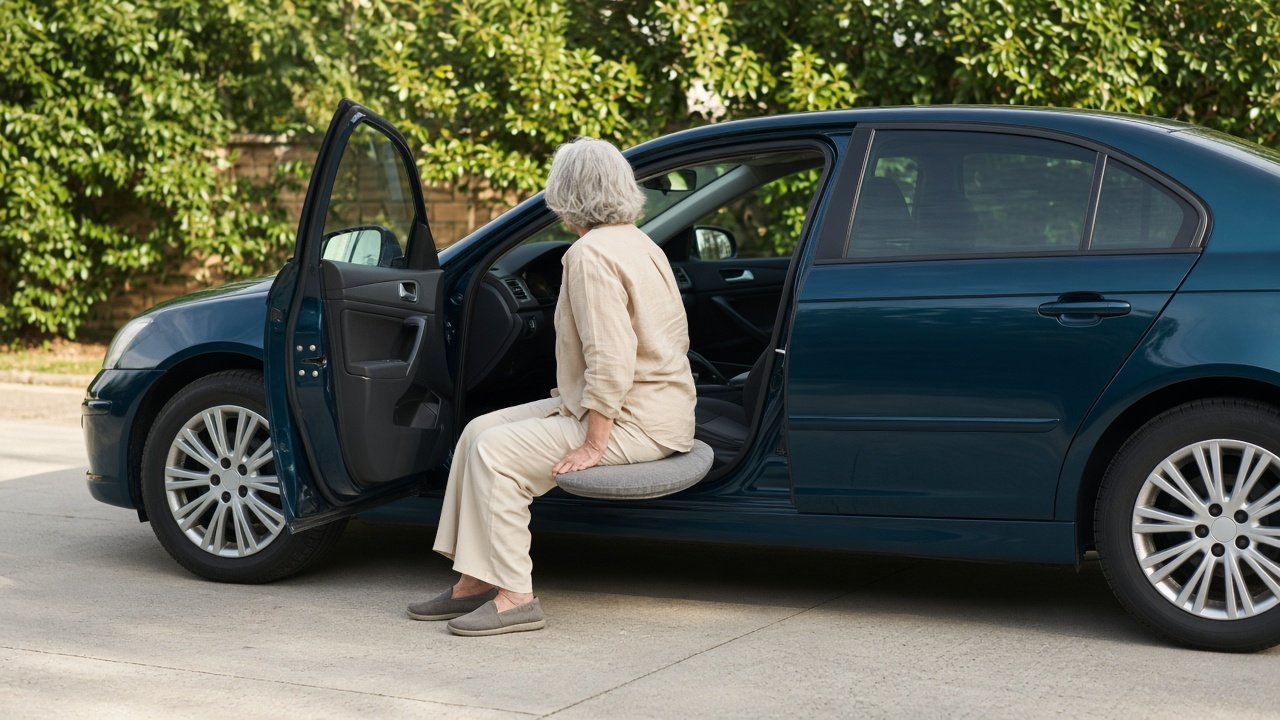
Getting in (adapted from Healthwise's sit-first method)
- Move the seat back and open the door fully.
- Turn your back to the car and back up until the seat touches the backs of your legs.
- Hold something stable: the seat back, the dashboard, or a door-frame handle (never the door itself).
- Duck your head and sit down slowly, sideways.
- Turn to face forward, lifting your legs in one at a time.
- Fasten the seat belt before the door closes.
Getting out: turn toward the door, swing both legs out, feet flat, scoot forward, hold on, stand slowly, and pause before walking.
Step 5: When to bring in a PT or OT
A physical therapist (PT) works on strength, balance, and safe movement. An occupational therapist (OT) focuses on daily tasks, equipment, and home setup. NIA notes a doctor might suggest an OT, PT, or nurse visit the home to assess its safety.
Ask the doctor about a referral if:
- ☐ Several warning signs apply, or any are getting worse
- ☐ Your parent fell or had a near-miss during a transfer
- ☐ They're dizzy every time they stand
- ☐ You're unsure which handle, cushion, or chair fits
- ☐ Someone is lifting or pulling your parent up
What about Medicare? Medicare.gov says Part B helps pay for medically necessary outpatient physical and occupational therapy when a doctor or other provider (such as a nurse practitioner or physician assistant) certifies the need. After the Part B deductible, your parent generally pays 20% of the Medicare-approved amount. Medicare.gov doesn't list a separate "home safety evaluation" benefit, so ask whether practicing transfers or reviewing the home setup can be part of the therapy plan, and what it will cost. If your parent has trouble leaving home, Medicare home health can include PT and OT if they meet certain conditions. Medicare Advantage plans may differ, so call the plan. See our guide to Medicare outpatient therapy after a fall.
Printable checklist: Getting In and Out Safely
Warning signs - ☐ Rocking to stand · pushing off furniture · dropping into seats - ☐ Grabbing walls after standing · dizzy on standing · near-misses - ☐ Several signs, or getting worse → call the doctor
Bed - ☐ Feet flat on the floor when sitting on the edge - ☐ Handle meets ASTM F3186-17, fits the bed, isn't recalled - ☐ Any rail: no gaps, strap secured, 12.5 in. from head/footboard - ☐ Light reachable while sitting - ☐ Roll → sit up → wait → light → slippers → scoot → hold → stand → pause
Chair - ☐ Knees no higher than hips; firm seat; sturdy armrests - ☐ No wheels, swivel, or rocker - ☐ Riser cushion that doesn't slide (feet still flat) - ☐ Stand: scoot → lean forward → push from arms → rise slowly - ☐ Sit: legs touch chair → both arms → lower slowly - ☐ Lift chair only after talking with the doctor or OT
Car - ☐ Seat back; get in from street level - ☐ Never lean on the door or headrest - ☐ Door handle: check for a U-shaped latch striker - ☐ Swivel cushion on flat seats only; check headroom and belt - ☐ In: back up → hold → sit sideways → legs in → belt - ☐ Out: legs out → feet flat → scoot → hold → stand → pause
Help - ☐ PT/OT referral asked for: date ____________ - ☐ Therapist practiced bed, chair, and car transfers - ☐ Coverage checked with Medicare or the plan
Key contacts: Doctor ____________ · PT/OT ____________ · CPSC recalls: cpsc.gov/Recalls
Sources (checked November 11, 2026)
- CPSC, Adult Portable Bed Rails (Safety Education Center): https://www.cpsc.gov/Safety-Education/Safety-Education-Centers/Adult-Portable-Bed-Rails
- CPSC, Adult Portable Bed Rails (business guidance; 16 CFR part 1270 / ASTM F3186-17): https://www.cpsc.gov/Business--Manufacturing/Business-Education/Business-Guidance/Adult-Portable-Bed-Rails
- CPSC recall, March 26, 2026 (recall 26-341): https://www.cpsc.gov/Recalls/2026/Vive-Health-Recalls-Adult-Portable-Bed-Rails-Due-to-Risk-of-Serious-Injury-or-Death-from-Entrapment-and-Asphyxiation-Two-Deaths-Reported
- CPSC recall, February 19, 2026 (recall 26-271): https://www.cpsc.gov/Recalls/2026/Vive-Health-Recalls-Adult-Portable-Bed-Rails-Due-to-Risk-of-Serious-Injury-or-Death-from-Entrapment-and-Asphyxiation-Violates-Mandatory-Standard-for-Adult-Portable-Bed-Rails
- CDC STEADI, Postural Hypotension: What It Is & How to Manage It: https://www.cdc.gov/steadi/pdf/STEADI-Brochure-Postural-Hypotension-508.pdf
- CDC STEADI, Chair Rise Exercise: https://www.cdc.gov/steadi/pdf/STEADI-Brochure-ChairRiseEx-508.pdf
- CDC STEADI, Family Caregivers: Protect Your Loved Ones from Falling: https://www.cdc.gov/steadi/pdf/steadi-caregiverbrochure.pdf
- National Institute on Aging, Falls and Fractures in Older Adults: https://www.nia.nih.gov/health/falls-and-falls-prevention/falls-and-fractures-older-adults-causes-and-prevention
- National Institute on Aging, Preventing Falls at Home: Room by Room: https://www.nia.nih.gov/health/falls-and-falls-prevention/preventing-falls-home-room-room
- MedlinePlus, Preventing falls: https://medlineplus.gov/ency/patientinstructions/000052.htm
- MedlinePlus, Taking care of your new hip joint: https://medlineplus.gov/ency/patientinstructions/000171.htm
- Healthwise (WebMD Ignite), Mobility Problems: Getting In and Out of a Car Safely: https://www.healthwise.net/dhweb/Content/StdDocument.aspx?DOCHWID=aby3697
- Medicare.gov, Physical therapy services: https://www.medicare.gov/coverage/physical-therapy-services
- Medicare.gov, Occupational therapy services: https://www.medicare.gov/coverage/occupational-therapy-services
- Medicare.gov, Home health services: https://www.medicare.gov/coverage/home-health-services
- CMS Medicare Coverage Database, LCD L33801 Seat Lift Mechanisms: https://www.cms.gov/medicare-coverage-database/view/lcd.aspx?lcdid=33801
- Stander, BedCane product page and support FAQ: https://stander.com/products/bedcane · https://stander.com/pages/2041-bedcane-support
- Stander, HandyBar product page and FAQ: https://stander.com/products/handybar
Educational information only; not medical advice. Talk with your parent's doctor, physical therapist, or occupational therapist about their specific situation.
Keep Reading
Related guides in Senior Safety
Trusted Help
Trusted Medicare cost help
Medicare costs, savings programs, and drug help can change by year and by state. Confirm the details with Medicare or your state before you rely on an estimate.
Use these links to verify eligibility, coverage, state rules, or local services before making a personal medical, legal, or financial decision.