
A practical family checklist for identifying adult portable bed rails, checking recalls and warnings, and organizing a professional review of the person and bed setup.
Scope and educational boundary: This guide helps older adults and family helpers in the United States organize a safety review of an adult portable bed rail or bed-assist handle. It is educational information, not medical advice, a product recommendation, an installation manual, or a determination that any rail is safe for a particular person. A qualified health professional should assess the person's needs. Confirm equipment compatibility with the manufacturers. Follow current official recall and warning instructions.
A handle beside a bed can look like a simple answer to a difficult night. Before buying one, reinstalling an old one after a move, or accepting a borrowed rail, check three separate questions: Is this product affected by an alert? Does it match this bed? Is a rail appropriate for this person?
First, identify what the product actually is
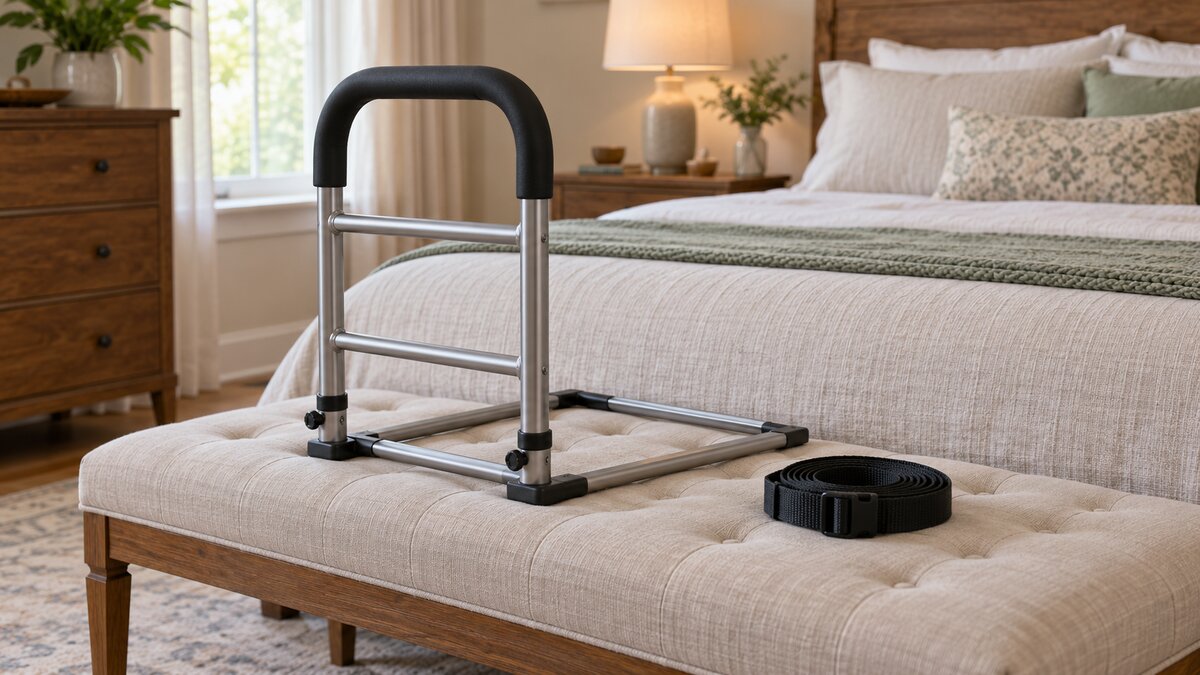
Names can obscure the category. Bed handles, assist bars, bed canes, and shorter side rails may all be adult portable bed rails. These are removable products added to a bed, rather than rails designed as part of a hospital-bed system. Children's portable rails are another category. The FDA's overview of bed-rail types explains these distinctions. A small handle deserves the same careful identification as a longer rail.
Entrapment means a person becomes caught in a position they cannot escape. It can happen within a rail or between the rail and mattress, among other places. The FDA's safety guidance warns that rails can cause serious injury or death and should not be used as restraints. Even a correctly designed and installed product may be unsuitable for some people.
Start with the task the person needs help doing
Write down the difficulty in ordinary language: turning in bed, sitting up, getting out of bed, or another specific activity. Ask the person what feels difficult and what they want help with. Bring that description to their clinician and, when appropriate, an occupational or physical therapist.
If the family's goal is to keep someone from leaving bed, describe that concern directly rather than treating a rail as the answer. Confusion, restlessness, limited muscle control, and some medical conditions can increase risk. The FDA's consumer recommendations emphasize individual risk and appropriate monitoring. Ask about alternatives and the support each option would require; do not substitute an improvised barrier.
- What assistance does the person need for the specific movement?
- What makes a rail unsuitable in their situation?
- What other equipment, bed arrangement, or human help should be considered?
- Who will explain the chosen plan to every caregiver?
Step 1: Make a product identification record
Gather information while the person is away from the equipment and appropriately supported. Do not ask them to demonstrate a problem or test whether they could become trapped. A simple record makes calls to a manufacturer, supplier, or clinician more useful.
- Brand, manufacturer, exact model number, and any lot or date code.
- Photographs of the product and its identification and warning labels.
- Purchase date, seller, receipt, and online order history, if available.
- The matching instruction manual and a list of missing or damaged parts.
- Bed-frame and mattress models, mattress thickness, and any topper or specialty surface.
- Who currently uses the rail, where it is installed, and the concern that prompted the review.
Check the box and manual if the model is not easy to find on the rail. Mark unknown details as unknown. A photograph that resembles a shopping listing is not enough to establish the model. For broader supplier and equipment questions, use YouRetire's durable medical equipment family checklist.
Step 2: Search both recalls and product safety warnings
Use the official CPSC recalls and product safety warnings search. Search the brand, model, and product category. Check both notice types and older notices, especially for a secondhand product. Open the actual notice and compare its model details, photographs, seller information, and sale dates with your record.
A useful search record includes the date checked, the official notice address, whether the identifying details match, and the action required. If the match is uncertain, contact the company or CPSC through an independently verified official channel before relying on the product. A search with no result does not establish safety or suitability.
Why the notice type matters
Two official examples illustrate the distinction. CPSC's April 2, 2026 expanded Sangohe recall identifies models 504E and 504Q, directs consumers to stop use immediately, and describes a refund process with specific proof requirements. Families must read that notice for the complete instructions.
Separately, CPSC issued an October 22, 2026 warning about Reliancer adult portable bed rails. It instructs consumers to stop using and dispose of the affected rails, and not to sell or give them away. The notice says the retailer had not responded to requests to conduct a recall or offer a remedy. A safety warning can therefore require action even without a company recall or refund offer.
These are examples checked on October 26, 2026, not a complete list. Reopen the current official notice before acting because its instructions or remedy information may change. Do not apply one product's repair, destruction, or refund procedure to another product.
Step 3: Check compliance separately from personal suitability
The CPSC's bed-rail FAQ explains that the mandatory standard in 16 CFR part 1270 applies to covered adult portable bed rails manufactured after August 21, 2023. It addresses matters including retention systems, structural integrity, entrapment, and warnings. Manufacturers or importers must issue a General Certificate of Compliance.
Ask the manufacturer for information tied to the exact model and manufacturing date, including the applicable compliance documentation. Keep its response with the manual. A recently purchased rail may have been manufactured earlier, and a familiar brand or positive review does not answer these questions.
Keep three separate entries in your notes: recall or warning status; manufacturer compatibility and compliance information; and the health professional's assessment. Completing one entry does not complete the others. An older product is not automatically safe because it predates the standard, and a compliance statement does not decide whether a person should use it.
Step 4: Review the whole bed setup
If a qualified professional recommends a rail, confirm the complete combination with the relevant manufacturers. The FDA cautions that rails, mattresses, and frames are not universally interchangeable. Mattress movement or compression, a topper, or a specialty mattress can create gaps. Installation must follow the manufacturer's instructions, including the specified retention system.
Use the appointment or supplier call to resolve practical questions:
- Is this exact rail compatible with this frame, mattress, thickness, and any adjustable positions used?
- Are all required components present, undamaged, and appropriate for the person's size and weight?
- Who will install it and demonstrate the correct checks and intended use?
- What changes mean the setup needs another assessment?
The CPSC's safety guidance also addresses the surrounding space: nearby furniture, headboards, footboards, and additional rails can create hazards. It advises against modifying rails, placing multiple rails next to each other, or climbing over them. Follow the specific product instructions and professional assessment rather than treating one measurement from the internet as a complete safety test.
Do not fill a gap with pillows, add a homemade strap, or alter a product to make an incompatible setup appear to fit. Pause and obtain qualified help. A family visual check cannot certify equipment. Review lighting, walking routes, and other room needs separately with the bathroom and bedroom safety guide.
Step 5: Give the ongoing review a named owner
A one-time setup is not the end of the process. The FDA's recommendations for health care providers call for regular reassessment of the person and equipment. Rails may loosen, equipment may change, or a person's needs may change. Ask the care team to explain the checks, frequency, warning signs, and contact plan for this situation.
Keep a short record of the last review, who performed it, concerns raised, and the next agreed action. Tell the responsible professional before transferring a rail to another bed or changing the mattress. If there is an entrapment or near-entrapment, seek immediate reassessment; the FDA warns that another event can follow quickly. Do not resume use simply because the person escaped the first time.
In a care facility, ask who approved the equipment, how the assessment is documented, and how staff will respond to a concern. Bring these questions to a care-plan meeting. Arrange review before bringing in a rail bought by a family member.
An illustrative family example
After Elena moves closer to her daughter, the family plans to reuse a bed handle from her former home. The new bedroom has a different mattress and a thick topper. Her daughter finds the old receipt and model number, checks official notices, and asks the manufacturer about the new combination. She also asks Elena's clinician to review the difficulty Elena describes when getting up.
The family records unresolved questions and arranges help with Elena's routine while the assessment is pending. They do not reinstall the handle merely because it worked before. This fictional example describes an organizing process, not a recommendation for a particular rail, alternative, or care arrangement.
Respond to a problem and protect personal information
If someone is trapped, cannot breathe, or faces another immediate danger, call 911. Follow the dispatcher's instructions and prioritize emergency care over photographs, receipts, or reporting forms.
For an affected recalled or warned-about product, follow the official stop-use instruction immediately. Contact the person's care team promptly for a workable support plan; do not continue using the product while waiting for a refund. Read the exact notice before handling, returning, or disposing of it. Keep affected equipment out of circulation and do not sell or donate it.
After immediate safety needs are addressed, save the model information, the date and description of the incident, and relevant photographs when safe to obtain. The FDA's bed-rail reporting guide explains that reporting routes depend on the product's intended use: FDA handles medical devices, while CPSC handles consumer products. Use the official reporting route and ask the agency if the classification is unclear.
Share health details only with people who need them for care or the official report. Crop unrelated medicine labels, mail, faces, and account information out of product photographs before sending them to a seller. Verify the recipient through the official notice rather than an unsolicited message. Keep the older adult involved in decisions and obtain appropriate permission for sharing their information.
Your next three actions
- Identify the exact product and check current official recalls and warnings.
- Take the person's specific difficulty and equipment details to a qualified professional.
- Record the agreed support plan, responsible person, and next review.
Sources
Official sources reviewed October 26, 2026. Product alerts, remedy procedures, and guidance should be rechecked when needed.
- FDA: Adult portable bed rail safety and product types
- FDA: Safety concerns and entrapment risks
- FDA: Recommendations for consumers and caregivers
- FDA: Recommendations for health care providers
- FDA: Reporting bed-rail problems
- CPSC: Adult portable bed rail safety guidance
- CPSC: Adult portable bed rail standard FAQ
- CPSC: Recalls and product safety warnings search
- CPSC: Expanded Sangohe recall, April 2, 2026
- CPSC: Reliancer product safety warning, October 22, 2026
Keep Reading
Related guides in Senior Safety
Trusted Help
Trusted home safety help
Use a practical checklist and re-check the home as health, mobility, medication, or memory needs change.
Use these links to verify eligibility, coverage, state rules, or local services before making a personal medical, legal, or financial decision.