
A practical family guide to sorting, securing, and safely disposing of expired or unused medicines, patches, liquids, and household sharps.
Educational note: This guide provides general information for older adults, adult children, caregivers, and families. It is not medical, legal, environmental, or pharmacy advice. Disposal rules and collection options vary by product and location. Read the medicine label, follow local requirements, and ask a pharmacist or other qualified health professional when you are unsure.
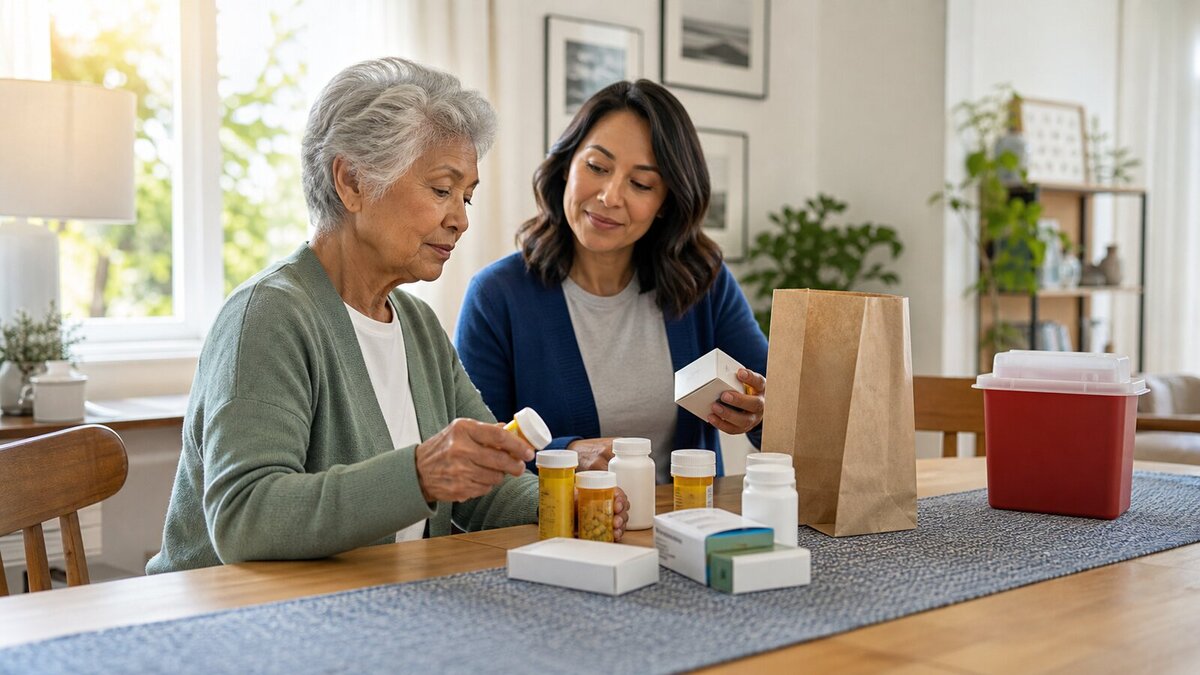
Unused medicine tends to accumulate quietly. A prescription changes after a hospital stay, a pain medicine is no longer needed, an inhaler expires, or a relative moves and leaves a crowded cabinet behind. The easy response is to put everything in one bag and deal with it later. The safer response is a short, organized review that separates current medicines from items ready for disposal and then uses the right disposal route for each item.
The U.S. Food and Drug Administration's disposal guidance says a take-back option is the best choice for most unused or expired prescription and over-the-counter medicines. But families also need a plan for the exceptions: products with special label instructions, medicines on the FDA flush list when take-back is not readily available, household-trash disposal, inhalers and sprays, and used needles or lancets.
Begin with a medication review, not a cleanup
Do not start by opening bottles, combining pills, or peeling off labels. First identify what is still being used. A bottle that looks old may contain a current prescription, and two bottles with similar names may have different strengths or instructions. If there is any doubt about whether a medicine was stopped, set it aside and call the pharmacy or prescriber before disposal.
Use a clear table or counter away from children, pets, food, and drinks. Keep every medicine in its original container while you sort it into four groups:
- Current: actively used and listed in the person's current medication record.
- Question: uncertain status, duplicate-looking bottles, or a recent dose change that needs confirmation.
- Ready for take-back: expired, discontinued, unwanted, or no longer needed.
- Special handling: needles, lancets, auto-injectors, inhalers, aerosol products, patches, liquids, or anything with disposal directions on the label.
This is also a good time to update the active medication list rather than simply throwing old items away. The FDA recommends recording prescription and nonprescription medicines, vitamins, and supplements along with the strength, purpose, and directions. Its medication-list guide explains why an accurate list can reduce confusion during appointments and emergencies.
A simple disposal decision path
For each item that is definitely no longer needed, use this order:
- Read the label and patient information. Follow any product-specific disposal instructions.
- Use a take-back option if one is readily available. This is the preferred route for most prescription and over-the-counter medicines.
- If take-back is not readily available, check the FDA flush list. Flush only when the product is on that list or its instructions specifically say to do so.
- If it is not on the flush list, use the FDA household-trash method.
- Keep sharps out of this path. Needles, syringes, lancets, and similar devices require a sharps container and local disposal instructions.
This sequence prevents two common mistakes: flushing every medicine and putting loose needles or recognizable pills directly in the trash.
How to use a drug take-back option
Families do not have to wait for a special event. The Drug Enforcement Administration says year-round locations operate at many pharmacies, hospitals, businesses, and law-enforcement sites. Start with the DEA's Every Day Is Take Back Day page and its official drop-off locator. The Environmental Protection Agency also lists pharmacy kiosks, law-enforcement kiosks, prepaid mail-back envelopes, community events, and the DEA's periodic take-back days as options in its household medicine disposal guide.
Before making a trip, call the location or check its posted rules. Ask:
- Does the kiosk accept prescription and over-the-counter medicines?
- Should pills remain in the original bottle, or may they be placed in a sealed bag?
- Are liquids accepted, and must they stay in the original leak-proof container?
- Are inhalers, aerosol products, or chemotherapy medicines excluded?
- Does the site accept controlled substances?
- Are needles, syringes, or other sharps prohibited?
- What are the kiosk's hours and accessibility arrangements?
Do not leave medicines beside a full or closed kiosk. Keep them secured and try another authorized location. If mobility or transportation is difficult, ask a pharmacy whether it offers a prepaid mail-back envelope and whether that program accepts the specific product.
When flushing is and is not appropriate
Flushing is not the general rule. FDA and EPA guidance both prioritize take-back. The FDA maintains a limited flush list for certain medicines that may cause serious harm if someone other than the patient takes even one dose. When a take-back option is not readily available, the FDA says a medicine on that list may be flushed immediately. Do not guess based on the drug's appearance, strength, or reputation; check the current FDA flush list or the product instructions.
If a medicine is not on the list and the label does not instruct flushing, do not put it down the toilet or sink. Use take-back or the household-trash method. This distinction is especially important when several family members are helping: write “take-back,” “check label,” or “trash method” on separate bags or containers so no one improvises later.
How to use the household-trash method
When no take-back option is readily available and the medicine is not on the flush list, FDA and EPA guidance allows many medicines to be placed in household trash using steps that make them less recognizable and harder to access:
- Remove the medicine from its original container.
- Mix it with an undesirable substance such as used coffee grounds, dirt, or cat litter. Do not crush tablets or capsules.
- Place the mixture in a sealed bag or disposable container with a secure lid.
- Put the sealed mixture in the household trash.
- Remove, cover, or scratch out the name, prescription number, and other personal information on the empty packaging before discarding it.
Keep the mixture out of reach while preparing it, and take the trash out promptly. Do not place loose pills in a wastebasket, recycling bin, compost, or an open container. If the product is a liquid, patch, spray, inhaler, or another unusual form, use its label directions or call a pharmacist rather than assuming the ordinary trash steps apply.
Sharps need their own plan
Needles and medicine are often stored together, but they should never be disposed of together. The FDA's home sharps guidance covers needles, syringes, lancets, auto-injectors, infusion sets, and connection needles. Used sharps should go into a sharps disposal container immediately after use.
An FDA-cleared container is preferred. If one is not available, the FDA says a heavy-duty plastic household container, such as an empty laundry-detergent bottle, may be an alternative. The container should be sturdy, upright, leak resistant, and fitted with a tight, puncture-resistant lid. Follow the container instructions and local rules for final disposal.
Never put loose sharps in household trash or recycling, and never flush them. Do not reach into a sharps container, force items through an opening, or try to empty a full container. Local rules differ, so check with the pharmacy, waste department, health department, or an official sharps-disposal resource before placing a sealed container out for collection.
Build a safer routine after a care change
The most useful cleanup happens at predictable transition points: after hospital discharge, after a specialist changes a prescription, after a move, after a death, or when a caregiver begins organizing medicines. A five-minute routine can stop old and current bottles from becoming mixed again.
Example: After Rosa returns home from rehabilitation, her daughter sees an old blood-pressure prescription, a new prescription with a different dose, an unfinished antibiotic, a box of expired test strips, and used lancets. She does not decide on her own which prescription should continue. She puts the two blood-pressure bottles in the “question” group, updates the medication list only after speaking with the pharmacy, places confirmed discontinued medicines in a locked bag for a pharmacy kiosk, follows the test-strip packaging instructions, and seals the lancets in the approved sharps container. One review produces both a safer medicine list and a clear disposal plan.
For ongoing safety, families can add these habits:
- Choose one secure, dry storage area for current medicines, away from heat, humidity, children, pets, and visitors.
- Keep “to be disposed” items in a separate locked container, not beside active medicines.
- Review expiration dates and the medication list every three to six months and after every major care transition.
- Do not share leftover prescriptions or save them for a future illness.
- Keep the pharmacy number with the medication list.
- Record the take-back location, hours, accepted items, and the next planned drop-off date.
Family medicine-disposal checklist
- Confirm each medicine is expired, discontinued, or no longer needed.
- Update the active medication list before removing old containers.
- Read every label for product-specific disposal instructions.
- Locate and confirm a year-round take-back kiosk or mail-back option.
- Check what the chosen location accepts before traveling.
- Use the FDA flush list only when take-back is not readily available.
- Use the sealed household-trash method only for appropriate non-flush-list medicines.
- Remove personal information from empty packaging.
- Put used needles, lancets, and auto-injectors in a proper sharps container.
- Keep all items secured until disposal is complete.
Next steps
Set aside 30 minutes, gather the current medication list, and sort without opening or combining containers. Confirm questionable prescriptions with the pharmacy. Then use the DEA locator or call nearby pharmacies to find an accepted take-back route. Handle sharps separately and write the next review date on the family calendar.
If someone may have swallowed, touched, inhaled, or injected the wrong medicine, do not wait for the cleanup to finish. Contact emergency services for severe or life-threatening symptoms, or call Poison Help at 1-800-222-1222 in the United States for immediate guidance.
Sources
- U.S. Food and Drug Administration: Disposal of Unused Medicines
- U.S. Food and Drug Administration: Flush List for Certain Medicines
- Drug Enforcement Administration: Every Day Is Take Back Day
- U.S. Environmental Protection Agency: What to Do With Unwanted Household Medicines
- U.S. Food and Drug Administration: Safely Using Sharps at Home, Work, and Travel
- U.S. Food and Drug Administration: Create and Keep a Medication List for Your Health
- U.S. Food and Drug Administration: Do Not Be Tempted to Use Expired Medicines
Keep Reading
Related guides in Senior Safety
Trusted Help
Trusted Medicare cost help
Medicare costs, savings programs, and drug help can change by year and by state. Confirm the details with Medicare or your state before you rely on an estimate.
Use these links to verify eligibility, coverage, state rules, or local services before making a personal medical, legal, or financial decision.