
A practical family guide to choosing, setting up, testing, and safely returning an over-the-counter hearing aid.
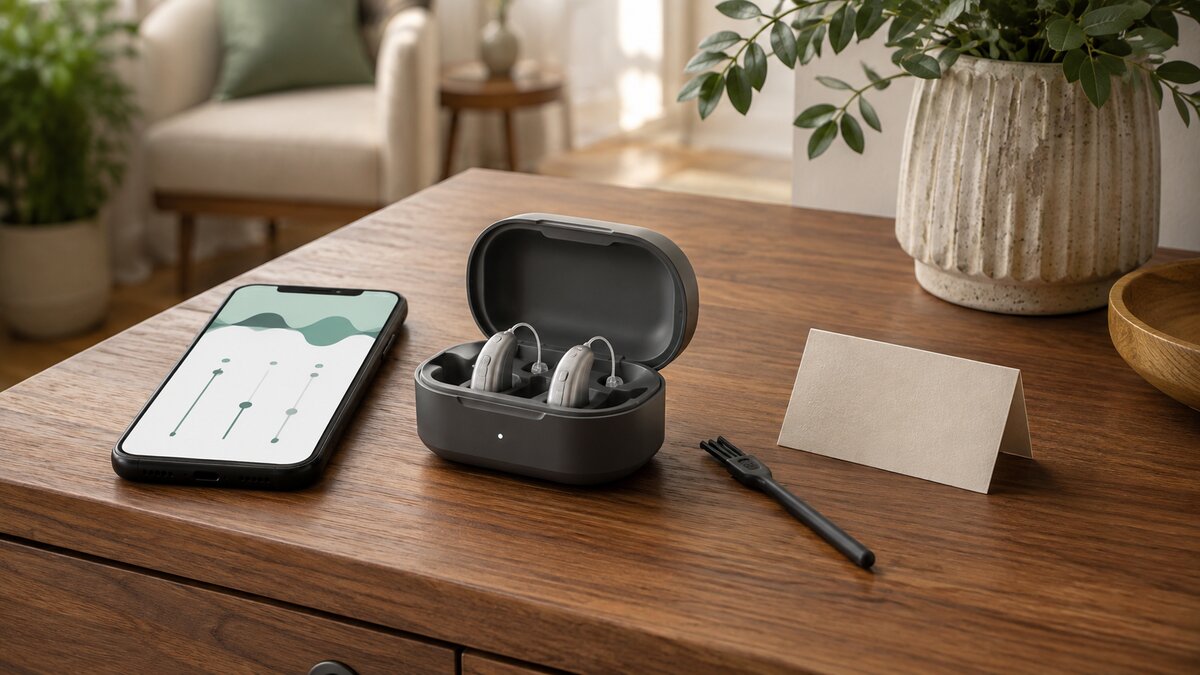
Scope and educational boundary: This guide is for adults in the United States who are considering an over-the-counter hearing aid and for family members helping with the shopping or setup. It offers an organizing framework, not a diagnosis or medical, insurance, financial, or legal advice. It does not recommend a brand. Hearing needs, ear symptoms, dexterity, vision, technology comfort, and coverage differ from person to person. An over-the-counter device can be a reasonable self-directed option for some adults, but it is not the right answer for every hearing problem.
The difficult part of buying a hearing aid is rarely finding a device for sale. It is deciding whether the over-the-counter route fits the hearing problem, understanding what is actually in the box, preserving a usable return window, and testing the device in the situations that matter. A family can help with those tasks while keeping the wearer in control of the decision.
Start with three different product lanes
The words used in stores and online can sound interchangeable, but they describe different products and levels of support.
- Over-the-counter hearing aids are FDA-regulated medical devices for people age 18 or older who perceive that they have mild to moderate hearing loss. They can be bought in a store or online without a medical exam, prescription, or required fitting by an audiologist. The user adjusts the device, sometimes with controls on the aid and sometimes through software or a phone app.
- Prescription hearing aids are fitted through a licensed hearing health professional. They may be appropriate for people of any age and for a wider range of hearing loss, including needs that an OTC device is not designed to address.
- Personal sound amplification products, or PSAPs, amplify sounds for people with normal hearing in particular situations, such as listening to wildlife. They are consumer electronics, not hearing aids for hearing loss.
The National Institute on Deafness and Other Communication Disorders and the Food and Drug Administration explain these distinctions. A product described only as a sound amplifier is not automatically an OTC hearing aid. Look for the words OTC and hearing aid on the package rather than relying on a search result, marketplace category, or seller description.
Decide whether a self-directed OTC trial fits
The FDA says the OTC category is intended for adults with perceived mild to moderate hearing loss. Everyday signs can include difficulty following speech in groups or noisy places, trouble on the phone, listening fatigue, or needing the television louder than other people prefer. Those examples help with self-selection, but they are not a hearing test.
Pause the shopping process and seek a hearing health professional if the person cannot follow speech in a quiet room, has difficulty hearing loud sounds, or suspects more severe hearing loss. The FDA's OTC hearing-aid guidance also identifies symptoms that call for medical attention rather than a retail solution. These include ear pain or drainage, blood or pus from an ear, suspected blockage or excessive wax, marked dizziness or vertigo, a sudden or rapidly changing loss, hearing that changes back and forth, or a noticeable difference between the ears, including ringing on only one side.
Do not use a family member's guess to explain away a new symptom. A clinician can check for problems that an amplifier cannot correct. If there are no warning signs but the family is unsure whether the loss is mild, moderate, or more significant, a professional hearing evaluation is still an available first step. Buying OTC is an option, not an obligation to manage the whole process alone.
Write a listening-task list before comparing devices
Features are easier to compare when the wearer first names the situations that are not working. Create a short list in the older adult's own words. For example:
- following one person across a quiet table;
- understanding a small family group or community meeting;
- hearing a television at a volume comfortable for everyone;
- using a mobile or landline phone;
- hearing a cashier, receptionist, clinician, or driver; and
- noticing household alerts without making every sound uncomfortable.
Choose two or three priority situations for the trial. This avoids a vague test of whether the device is simply louder. It also reveals when another tool may solve a specific problem better. For phone calls, the YouRetire guide to captioned phones and relay services explains communication options that can complement, rather than compete with, a hearing-aid plan.
Read the outside of the box before paying
FDA rules require useful information on the outside packaging of an OTC hearing aid. If an online listing does not show the package information clearly, ask the seller or manufacturer for it before placing the order. Check for:
- the words OTC and hearing aid;
- the age limitation and the hearing-health warnings;
- a clear statement of the manufacturer's return policy, including if there is no return policy;
- whether the device is new, used, or rebuilt;
- the battery type, quantity, and whether batteries are included;
- whether a smartphone or separate remote control is required; and
- how to obtain the full instructions and contact the manufacturer.
Do not treat an official-looking seal as the decision. The FDA warns that phrases such as “FDA Registered” or “FDA Certified,” and use of the FDA logo, may be misleading. FDA establishment registration or device listing does not itself mean that the agency approved, cleared, or authorized a particular product. The agency's explanation of registration, certification, approval, and clearance can help a family evaluate a seller's claim without turning the purchase into a regulatory investigation.
Compare the complete setup, not one advertised feature
A hearing aid that is difficult to charge, insert, adjust, or return may not be practical even when its feature list looks impressive. Compare each candidate against the same family checklist:
- Control method: Can the wearer operate the buttons or app without assistance? Is the phone model and operating system compatible? Can basic volume or program changes still be made if the phone is unavailable?
- Physical handling: Can the person tell left from right, place the device correctly, change tips or filters, and open the battery door or charging case? Consider tremor, arthritis, sensation, and vision without assuming that age alone determines ability.
- Power and supplies: Is the device rechargeable or battery-powered? What charging cable, batteries, wax guards, domes, cleaning tools, or replacement parts will be needed, and where can they be obtained?
- Support: Is help available by phone, chat, video, or in person? Are setup appointments included or sold separately? Write down the hours and contact route.
- Return and warranty terms: How many calendar days are available? When does the clock start? Is there a restocking fee or return-shipping cost? What happens if the device is opened, paired to an app, or missing packaging? What repairs, replacement, loss, or damage does any warranty cover?
- Total cost: Add the device, accessories, replacement supplies, optional support, and any recurring charges. Do not assume that a higher price guarantees a better fit or that a low advertised price includes two aids.
The FDA does not require an OTC hearing-aid manufacturer to provide a warranty, so the written return and warranty terms matter. The Federal Trade Commission's warranty guide recommends reading what is covered, who handles a claim, and whether the remedy is repair, replacement, or refund. Save the product page, package details, receipt, order confirmation, return terms, and warranty as they appeared on the purchase date. Get spoken promises in writing.
Check coverage without assuming reimbursement
Medicare's current coverage page says Original Medicare does not cover hearing aids or exams for fitting them. Some Medicare Advantage plans offer extra hearing benefits, but the details are plan-specific. Before buying, ask the plan whether the particular purchase channel or device is eligible, whether a network provider is required, what documentation is needed, and whether an allowance is paid at purchase or reimbursed later. A verbal answer is useful, but keep the plan document or written message that supports it.
The broader YouRetire guide to dental, vision, and hearing coverage in retirement can help families place this purchase within the larger coverage picture. Do not delay needed professional evaluation solely because a retail device appears less expensive.
Create a return-window trial plan
Before opening the package, put three dates on a calendar: the delivery or purchase date, the final date for starting a return, and a family decision date several days earlier. Keep the box and every accessory until the decision is final. Then use a simple trial:
- Read the manufacturer's instructions before placing or charging the devices. Confirm left and right, battery safety, cleaning, storage, and any app requirements.
- If an app is needed, download it from the official app store link identified by the manufacturer. Review what account, Bluetooth, microphone, location, contact, or analytics permissions it requests. Grant only permissions needed for the feature being used.
- Begin in a quiet, familiar setting. Learn insertion, removal, charging, volume, and one program at a time. Do not make several adjustments at once and then guess which change helped.
- Practice regularly as the instructions direct. FDA guidance notes that adjustment takes time and that users may need practice with placement, controls, and different listening environments.
- Test the two or three priority tasks from the listening list. Record the setting, comfort, speech understanding, unwanted noise, battery performance, and any support call. “Better” should describe a real task, not only louder sound.
- Review the notes before the family decision date. If the device is not helping enough, is too difficult to manage, or needs support beyond what is available, contact a hearing health professional while the return option is still open.
A family helper can assist with charging, app navigation, note-taking, or a support call, but should not take over the wearer's account or pressure the person to tolerate discomfort. Keep account credentials private, use the older adult's preferred contact information, and agree on whether the helper may receive support messages. The guide to hearing loss, communication, and caregiver safety offers additional ways to reduce missed information while a device plan is being tested.
An illustrative family example
This example is fictional and does not predict a result. Daniel can follow one-on-one conversation in a quiet room but struggles at a weekly card game and often asks for television dialogue to be repeated. He has no pain, drainage, sudden change, one-sided symptoms, or major difficulty with loud sounds. He decides to try an OTC hearing aid rather than choosing from an advertisement immediately.
Daniel and his daughter write down two goals: follow the card-table conversation and use the television at a shared volume. They compare two devices using the same checklist. One requires a phone Daniel does not own. The other has physical controls, written support, and a return period long enough for a structured trial. They save the package information and receipt, schedule a decision date before the deadline, and test the device in both settings. Their notes give Daniel a concrete basis to keep it, return it, or take the results to an audiologist. The useful outcome is an informed next decision, not a promise that an OTC device will solve every listening problem.
Know when to stop the trial or escalate a problem
Stop using the device and contact an appropriate health professional if it causes pain, injury, persistent irritation, a piece becomes lodged in the ear, or hearing suddenly worsens. New drainage, bleeding, marked dizziness, rapidly changing hearing, or a one-sided change also belongs in the medical lane, not the customer-service lane.
For a malfunction or product-quality issue, preserve the device, packaging, model and serial information, receipt, app version, and a brief timeline. Contact the seller or manufacturer under the written terms. Consumers can report injuries, malfunctions, and other adverse events involving hearing aids through FDA MedWatch. Families can also check the agency's medical-device recall and early-alert page. A recall notice may call for a check, adjustment, repair, or return, so follow the instructions for the exact model rather than guessing.
If the dispute is about an unhonored return, warranty, shipment, or seller promise, keep copies of every message and ask for a specific resolution in writing. The FTC warranty guidance explains escalation options, including state consumer-protection offices and the FTC's reporting channel. A sales dispute and a health concern can happen at the same time; handle each through the appropriate channel.
A concise next-action plan
- Write two or three listening tasks that the older adult wants to improve.
- Check for FDA warning signs or evidence that the hearing difficulty is beyond the OTC range.
- Compare the outside-box labeling, control method, support, supplies, total cost, return policy, and warranty.
- Confirm any insurance benefit in writing before purchase.
- Save the purchase record and schedule a decision date before the return deadline.
- Test the device methodically, protect app privacy, and seek qualified help if symptoms, poor benefit, discomfort, or setup barriers make self-directed use a poor fit.
The best purchase process is not the one with the most features. It is the one that matches the person's hearing situation and daily abilities, preserves a realistic way to return the product, and makes the next step clear if the device is not enough.
Sources
- U.S. Food and Drug Administration: OTC Hearing Aids — What You Should Know
- National Institute on Deafness and Other Communication Disorders: Over-the-Counter Hearing Aids
- U.S. Food and Drug Administration: Hearing Aids and Personal Sound Amplification Products — What to Know
- U.S. Food and Drug Administration: FDA Registered, FDA Certified, Approved, and Cleared Devices
- Federal Trade Commission: Warranties
- Centers for Medicare and Medicaid Services: Medicare Hearing Aid Coverage
- U.S. Food and Drug Administration: How to Use the Consumer Complaint System and MedWatch
- U.S. Food and Drug Administration: Medical Device Recalls and Early Alerts
Keep Reading
Related guides in Senior Safety
Trusted Help
Trusted Medicare cost help
Medicare costs, savings programs, and drug help can change by year and by state. Confirm the details with Medicare or your state before you rely on an estimate.
Use these links to verify eligibility, coverage, state rules, or local services before making a personal medical, legal, or financial decision.