
Plan safe drop-offs for batteries, leftover paint, household chemicals, and old electronics while downsizing, with a family checklist and device-privacy steps.
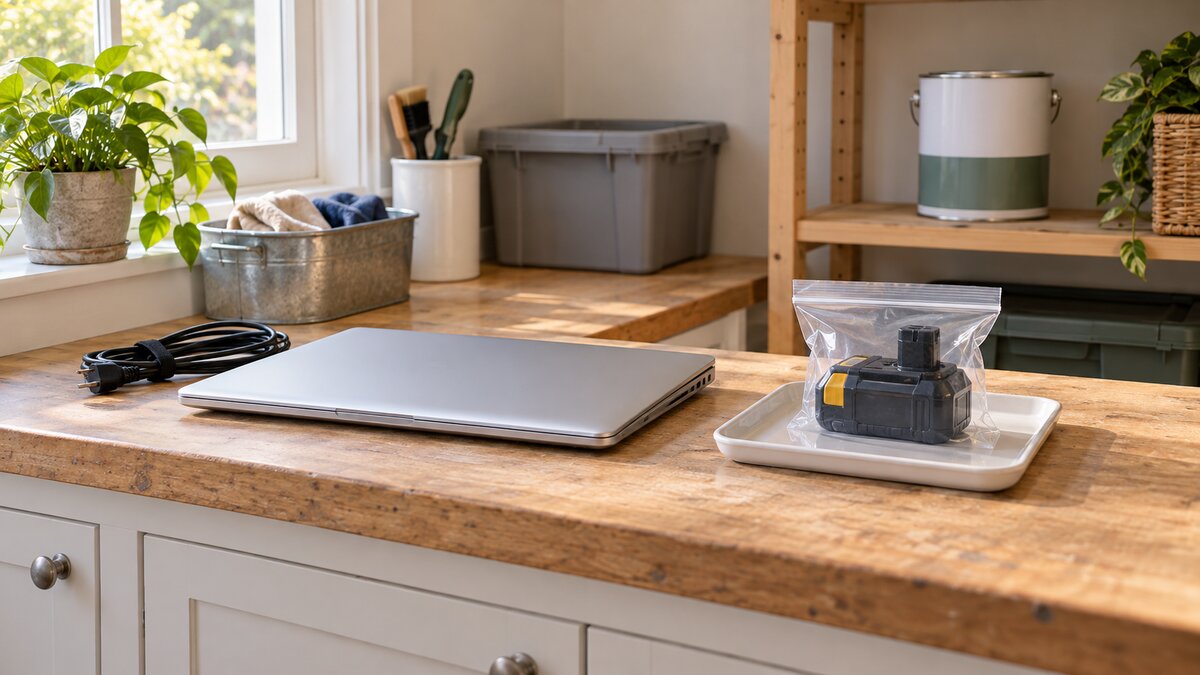
Scope and educational boundary: This guide helps older adults and family helpers in the United States organize the disposal of batteries, leftover paint, household chemicals, and old electronics during a move or home cleanout. It provides educational planning information, not instructions for battery repair, chemical cleanup, or hazardous-material transport. Your local waste authority, collection program, and product manufacturer control the instructions for a particular item. If something is leaking, damaged, unidentified, or unsafe to approach, stop and ask for qualified help.
A downsizing plan can work well until the family reaches the garage shelf and the drawer of old devices. A half-full paint can does not belong in the same decision pile as a spare blanket. A laptop may need both a recycling destination and a privacy check. The practical goal is to give each difficult item a confirmed destination before moving day, without asking the older adult to handle everything personally.
Start with four routes out of the home
Keep the ordinary keep, sell, donate, and discard decisions in your broader room-by-room downsizing plan. Add a separate disposal list for items that need another question answered first:
- Household chemicals: What is the product, and which local program accepts it?
- Batteries: What chemistry is marked on the battery, and is it removable and undamaged?
- Electronics: Can the item be reused, and what battery and personal-data steps are needed?
- Uncertain items: Who can identify the item or give safe handling instructions before anyone moves it?
These are planning categories, not directions to put unlike materials together in four boxes. Leave products safely stored according to their labels while confirming their routes. Medicines and household sharps need a separate process; use YouRetire's unused-medication disposal guide rather than treating them as ordinary cleanout rubbish.
Make a list before consolidating anything
Walk through one manageable area with the older adult's agreement. Record the product name, approximate quantity, condition, and storage location. Read labels without opening containers to inspect or smell the contents. A photograph can help with an inquiry, but only take it when the item is safe to approach.
The EPA's household hazardous waste guidance identifies products such as certain paints, cleaners, oils, and pesticides as needing particular care. Follow the product's storage and disposal directions, keep the original container and label, and do not combine leftovers. A food jar is not a substitute container. Even an apparently empty container may retain hazardous residue.
For a corroding container, EPA directs people to a local hazardous-materials official or fire department for instructions. An unknown bottle is a question for that official, not a family identification experiment. Keep the cleanout timetable flexible enough for an unresolved item to remain unresolved until you receive instructions.
Give batteries their own decision path
Shape alone does not identify a battery. The EPA's household battery guide distinguishes types by their markings and chemistry. Its recommendations differ:
- Alkaline and zinc-carbon: Check the local or state waste authority for the applicable route; EPA recommends recycling or checking with that authority. Do not turn a rule from another town into your own disposal instruction.
- Coin, button, and single-use lithium batteries: Keep them out of household trash and municipal recycling bins. Follow the battery guide's terminal-isolation and collection instructions, and keep small cells away from children.
- Rechargeable batteries: Use an accepting battery recycler, participating retailer, or household hazardous waste program. Do not put them into household trash or curbside recycling.
For lithium-ion batteries, including those in laptops and power tools, EPA specifically warns against household garbage and municipal recycling. Crushing during collection can create a fire hazard. For ordinary, undamaged items, follow EPA's guidance about separate plastic bags and nonconductive tape over exposed battery terminals, together with the receiving program's instructions.
Do not pry open a sealed device to remove a battery. Some batteries are not serviceable by the user; an accepting whole-device electronics program may be the appropriate route. If a battery or device is damaged, contact its manufacturer for specific handling information before preparing it for collection. Damaged items may require a different arrangement. Large vehicle or home-energy batteries belong with the manufacturer, installer, or dealer's guidance, outside this household sorting exercise.
Confirm the exact paint or chemical, not just the collection site's name
Before making a trip, tell the receiving program what the original label says. “Paint” could mean several different products. Ask about the specific coating or chemical, its container, its condition, and the amount. Ask separately about solvents, sprays, and other products found beside it.
A useful example is Washington's PaintCare guidance. That state program accepts covered architectural paints but excludes certain other products, including aerosols and solvents. Its instructions call for checking acceptance and hours in advance and retaining original labels and lids. Those are Washington program details, not a promise about a collection site elsewhere.
Do not assume that drying, draining, mixing, or pouring away a product is acceptable because someone remembers doing it years ago. Get the current local instruction for that exact material. Write the answer beside the item on your list so a second helper does not start the investigation again.
Clear personal information before electronics leave
Electronic disposal has two separate completion points: the owner has dealt with the information, and the receiving program has accepted the physical item. Permission to carry a computer to a recycler is not permission to browse its files or erase it. Agree with the older adult on who will do the privacy work.
Computers
The FTC's computer-disposal guidance puts backup before erasing or resetting the machine, followed by proper donation or recycling. Choose the files to preserve, check that the backup can be opened, and use the current operating-system maker's erasure instructions. Moving a few photos or deleting visible documents is not a completed disposal plan.
If the device will not start, the owner cannot sign in, or the instructions are unclear, keep the item pending while arranging trustworthy technical help. Ask what will be done to stored information and what confirmation the service provides. Do not promise the family that an unspecified reset makes every device or storage medium safe to release.
Phones
The FTC's phone-disposal guidance covers backup, removable SIM and memory cards, and restoring or resetting the phone. It also flags telephone-number updates and authenticator-app continuity. Follow current manufacturer and carrier instructions for the actual phone, including any eSIM.
Before erasing an old phone, confirm that the replacement can receive needed verification messages and that essential account access works. For the larger account-organizing project, use YouRetire's digital downsizing guide. Keep passwords, recovery codes, and copies of identity documents out of the shared disposal checklist.
Check reuse and recall questions before offering an item
A working electronic item may have a reuse route. The EPA's electronics donation and recycling page points to local facilities and manufacturer or retailer options. Confirm that the program accepts the actual device and its battery arrangement; a general electronics sign does not settle every item.
Before listing a used consumer product for sale, check the model against recall information. The CPSC's buying and selling FAQ explains that good appearance does not make an unrepaired recalled product lawful to sell. It distinguishes products that have received the remedy specified in the recall. Follow that product's actual recall instructions rather than improvising a repair or passing the problem along.
Use one call sheet for every proposed handoff
Contact the local environmental, health, or solid-waste office to identify the right household collection options. Then confirm details with each receiving program. A family member can make these calls without transporting the materials first.
A practical opening is: “We are helping with a household move. We have this product, in this amount and condition. Do you accept it, and what should we do before bringing it?” Record:
- The program's name, official contact details, and the date of the answer.
- The exact accepted item, including any battery or container restrictions.
- Whether an appointment, proof of residency, or advance registration is required.
- Any quantity limits, fees, and loading or packaging instructions.
- Whether staff can help unload, and what to arrange if the family cannot lift safely.
- The route for rejected, damaged, unidentified, or otherwise exceptional items.
Ask these as questions, not assumptions about services the program provides. Reconfirm arrangements if the item, date, or condition changes. Do not post the older adult's address or photographs of private paperwork in a public request for cleanout help.
Build a schedule that leaves room for unfinished questions
Give each list entry a status: awaiting instructions, appointment arranged, privacy work pending, or handoff completed. Put one named helper beside the next action. Someone who cannot carry a box can still verify a location, make a call, or preserve a receipt.
Work backward from the move date. Set aside an early session for calls and identification, another for device privacy work, and the confirmed collection appointment. Keep a final review for items that were refused or overlooked. Ask the moving or cleanout company what it will accept; a household collection plan does not establish permission to put an item on its truck.
Agree on a stopping point for each session. A family cleanout should not depend on the older adult repeatedly climbing, lifting heavy containers, or making every decision at once. Leave technical and handling questions with the appropriate service rather than turning the last afternoon into an improvised solution.
An illustrative family example
This example is fictional. Elena is moving to a smaller apartment. Her son finds old paint, a cordless-tool battery, and two laptops. Instead of arranging one mixed pickup, they list the items separately. Elena chooses which files matter; her niece helps with backup and the manufacturers' reset instructions.
Her son confirms a paint appointment and asks the battery program about its preparation requirements. One laptop needs more technical help, so its status stays pending. The family records completed drop-offs and assigns the remaining question to one person. Progress means confirmed decisions, not an empty garage achieved at any cost.
Your next three actions
- Choose one small area. List difficult items without opening, combining, or dismantling them.
- Confirm destinations. Call the local authority and receiving programs about the exact materials and any exceptional condition.
- Assign and document the handoffs. Finish device privacy work before release, follow the instructions received, and mark only accepted items complete.
If a question remains unanswered, keep it visible on the list. A safe plan includes knowing when the family needs official or qualified help.
Sources
Primary guidance checked October 15, 2026. Collection arrangements and device procedures can change; check the current local program and manufacturer instructions when acting.
- U.S. Environmental Protection Agency: Household Hazardous Waste (HHW).
- U.S. Environmental Protection Agency: Used Household Batteries.
- U.S. Environmental Protection Agency: Used Lithium-Ion Batteries.
- U.S. Environmental Protection Agency: Electronics Donation and Recycling.
- Federal Trade Commission: Remove Personal Information Before Getting Rid of a Computer.
- Federal Trade Commission: Remove Personal Information Before Getting Rid of a Phone.
- U.S. Consumer Product Safety Commission: For Buying and Selling Products Online.
- Washington State Department of Ecology: Paint stewardship: PaintCare.
Keep Reading
Related guides in Downsizing
Trusted Help
Trusted planning and legal help
Forms and legal requirements vary by state. Use these sources to prepare questions and then confirm the right document with a qualified professional.
Use these links to verify eligibility, coverage, state rules, or local services before making a personal medical, legal, or financial decision.