
Real Estate for Retirees
Reasonable Accommodations and Modifications for Older Renters: A Family Request Guide
A practical family guide to requesting disability-related rule changes and physical modifications in rental housing, with privacy, cost, documentation, and follow-up steps.
Scope and educational boundary: This guide explains a federal Fair Housing Act request process for older renters and family helpers in the United States. It is educational information, not legal, medical, construction, or housing advice. Age alone is not the federal disability test. Whether a particular request is required, who must pay, and which deadline or program rule applies depend on the person's disability-related need, the housing, the funding program, state and local law, the lease, and the facts. A request does not guarantee approval or payment.
A small housing barrier can become a daily risk. A first-come parking rule may leave a renter with limited walking ability far from the entrance. A heavy door may be difficult to open while using a walker. A bathroom may need grab bars. A leasing office may insist on in-person paperwork that a resident cannot safely complete there. Families often describe all of these as “accessibility,” but the request works better when everyone first identifies which kind of problem needs to be solved.
Start with the three different lanes
1. A reasonable accommodation changes a rule or service
A reasonable accommodation adjusts how a housing provider applies a rule or delivers a service so a person with a disability can use the home on equal terms. The current federal accommodation regulation includes an example in which a renter with limited walking ability needs an assigned space near the unit even though parking is normally first come, first served.
Other requests might involve an accessible way to communicate with management, an exception to an in-person procedure, or a policy change that allows a helper to complete a disability-related task. The important link is not the renter's age. It is the relationship between a disability-related limitation and the change needed to use the housing.
2. A reasonable modification changes the physical space
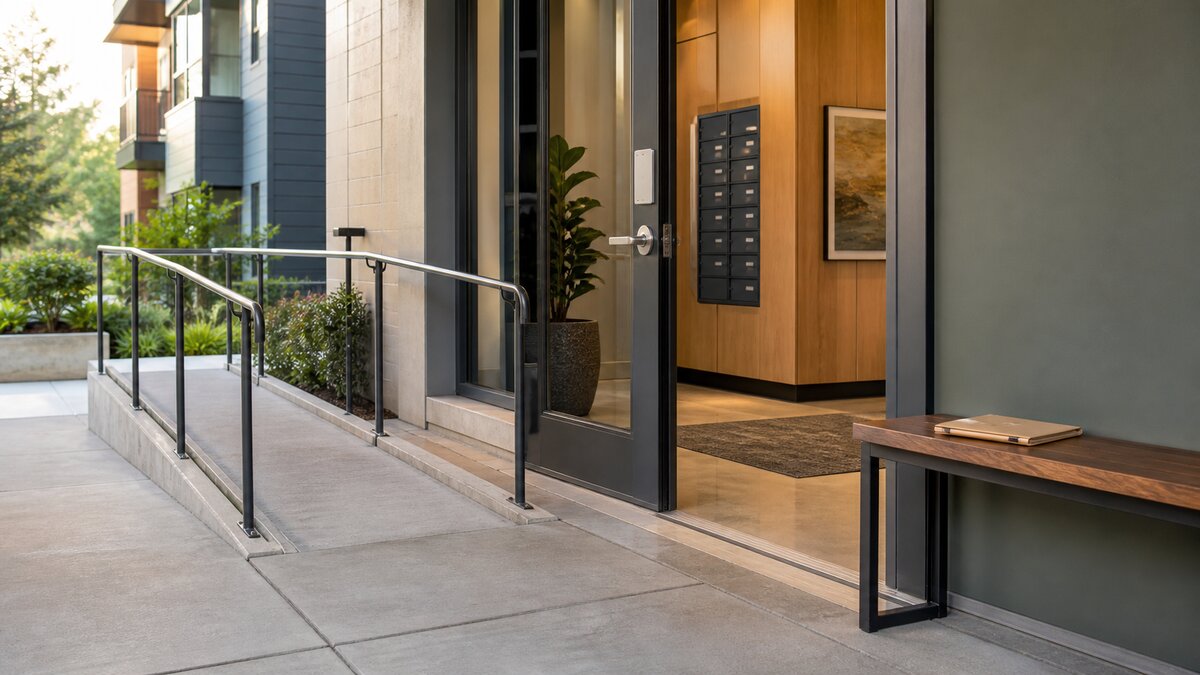
A reasonable modification alters a physical feature of a unit, entrance, or shared area to remove a disability-related access barrier. The HUD and Justice Department joint modification guidance gives examples such as widening a doorway, adding bathroom grab bars, lowering cabinets, installing a ramp, or altering a walkway.
A renter should obtain the housing provider's approval before starting a modification. Approval is not the same as a promise that the landlord will pay. Cost depends on which law and housing program applies, so keep that question separate from permission.
3. An ordinary repair fixes something that should already work
A broken exterior light, loose handrail, leaking pipe, or nonworking lock may be a maintenance or habitability issue rather than a new disability-related modification. Report the defect through the normal repair process and preserve the date, photos, and response. If a disability-related change is also needed, label that request separately. Do not let an ordinary repair disappear inside a broader accessibility conversation.
A family request workflow
1. Describe the barrier and the needed result
Begin with function, not a stack of diagnoses. Write down the task the renter cannot use equally, the barrier, and the result that would solve it. For example: “Because walking more than a short distance is substantially limited, I need an assigned accessible parking space near the entrance.” For a modification: “Because stepping over the tub edge is not safe with my mobility limitation, I am requesting permission to install professionally mounted grab bars at my expense.”
This framing helps show the identifiable connection between the disability-related limitation and the request. It also helps a clinician, therapist, fair-housing counselor, or family member understand what information is actually needed.
2. Identify every decision-maker before sending the request
List the property owner, manager, leasing office, homeowners association if one is involved, and any public housing agency or other program connected with the rent. Ask whether the provider has a request form and where it should be delivered. A preferred form can make routing easier, but the HUD and Justice Department joint accommodation guidance says a provider must still consider a recognizable request even when it is oral or does not use the provider's form.
A family member or another person acting for the renter can make the request. Get the renter's permission when possible, state that the helper is acting on the renter's behalf, and keep the renter involved in choices. Do not assume that being an adult child automatically gives authority to receive private records or sign lease documents.
3. Make one clear written request
The law does not require magic words such as “reasonable accommodation,” but writing is usually safer because it creates a shared record. A simple request can include:
- the renter's name, unit, and safe contact method;
- the exact rule, service, or physical feature creating the barrier;
- the accommodation or modification requested;
- the disability-related connection, without unnecessary medical detail;
- for physical work, a basic design, location, installer plan, permit plan, and proposed timing;
- a request for written confirmation, any needed next step, and a prompt decision; and
- a backup request only if it would genuinely meet the same need.
Save the letter, attachments, delivery receipt, portal confirmation, and a note of any oral conversation. If the need is tied to a fall risk, discharge date, expiring voucher, inspection, or threatened loss of housing, state the real date without exaggerating it.
4. Protect medical privacy
If both the disability and the need are obvious or already known, the federal joint guidance says a housing provider may not ask for additional disability information. If either is not apparent, a provider may request reliable information needed to verify a qualifying disability, describe the requested change, and show the disability-related connection. In most cases, detailed medical records are not necessary.
Ask a supporting professional to describe the functional limitation and why the requested housing change is needed, not to send a complete chart. Do not send Social Security numbers, portal passwords, unrelated diagnoses, bank records, or a medication list unless a separate program lawfully requires specific information. Confirm the recipient and use a secure delivery method.
5. Plan physical work before anyone picks up a tool
For a modification, wait for approval. Under 24 CFR 100.203, a landlord may ask for a reasonable description of the proposed work, reasonable assurance that it will be done in a workmanlike manner, and any required building permits. The HUD and Justice Department guidance says a provider generally cannot insist on a particular contractor, but can require a capable installer and necessary permits.
Before signing a contract, put the scope, materials, access schedule, cleanup, insurance, permits, payment stages, and responsibility for damage in writing. Use the YouRetire guide to paying for aging-in-place modifications to organize possible funding questions, but verify that any program can be used in a rental and that approval is in place before spending money.
6. Track the response and discuss workable alternatives
Federal guidance does not set one universal number of days for every request, but it says providers must respond promptly and that undue delay may amount to a failure to accommodate or permit a modification. Keep a dated log. If there is no acknowledgment, send a short follow-up with the original request attached and ask what information is still needed.
A provider may suggest an alternative. Compare it with the renter's actual functional need, safety, timing, privacy, and cost. The joint guidance encourages an interactive discussion when the first proposal may create an undue financial or administrative burden or fundamentally alter the provider's operations. An alternative is useful only if it effectively meets the disability-related need.
Who pays for what?
Keep these starting rules separate:
- Accommodation: A housing provider may have to absorb some cost of a reasonable rule or service change unless it creates an undue financial and administrative burden or fundamentally alters operations. A provider may not charge an extra fee or deposit simply as a condition of granting a reasonable accommodation.
- Modification in ordinary private housing: Under the Fair Housing Act baseline, the renter generally pays for the structural change, while the provider must permit a qualifying reasonable modification.
- Federally assisted housing: Section 504 can require the housing provider to make and pay for needed structural changes unless a recognized burden, alteration, or effective-alternative limit applies. Ask the housing agency or property which federal assistance and rules cover the unit.
- Preexisting accessibility requirement or ordinary repair: A feature may already be required by building-accessibility law, program standards, or the lease. Do not agree that a renter must pay until the issue is correctly classified.
For a renter-paid modification, the provider cannot simply increase the usual security deposit because of the request. A reasonable restoration agreement may sometimes cover interior changes at move-out. In limited circumstances, the regulation allows a negotiated interest-bearing escrow for reasonable restoration costs; it is not an automatic flat accessibility fee. Exterior and common-area restoration rules differ, and the details can be important. Get any restoration obligation in writing before work begins.
An illustrative family example
Illustrative example: Lena uses a walker and rents an apartment with her spouse. Her assigned space is far from the entrance, the bathroom lacks a safe handhold, and a common-area light has stopped working. Her son helps her prepare three clearly labeled items: a reasonable accommodation request for a closer accessible parking space, a reasonable modification request for professionally installed grab bars, and an ordinary maintenance report for the failed light.
The parking request explains the limited walking function and the needed location. The grab-bar request includes a simple drawing, installer information, and a question about who pays because the property may receive federal assistance. The maintenance report includes a photo and the date first reported. Lena shares only disability-related information needed for the two requests. The family tracks each response separately instead of letting the manager answer all three with one vague email.
If the request is delayed or denied
- Ask for the decision in writing. Request the reason, the information relied on, and any proposed alternative.
- Check whether the record is complete. Keep the request, support letter, delivery proof, follow-ups, responses, lease provisions, photos, estimates, permit information, and a dated timeline.
- Use the correct program contact. A Housing Choice Voucher participant can contact the public housing agency; HUD's current voucher-tenant guidance specifically recognizes requests for accommodations and modifications. Other subsidized properties may have their own coordinator, grievance, or compliance contact.
- Get qualified help when the stakes are high. Contact a local fair-housing organization, legal-aid office, disability-rights organization, or qualified housing attorney if eviction, lease termination, an unsafe barrier, retaliation, or a deadline is involved. The YouRetire guide to Area Agencies on Aging can help a family locate local support pathways, but it is not a substitute for legal advice.
- Do not let complaint time expire while negotiating. HUD's current FHEO process page says a Fair Housing Act allegation generally must be filed within one year of the last alleged discriminatory act and recommends filing as soon as possible. The HUD reporting page provides online and telephone intake routes. State, local, program, and court deadlines may be different.
If a move becomes the safer or chosen path, preserve the request record and use the YouRetire senior-housing waitlist and recertification guide to keep applications, contact updates, and notices organized. Use the pre-move document checklist so medical, benefit, lease, and authority papers do not disappear during the transition.
Privacy and safety cautions
- Do not install a ramp, grab bar, door opener, flooring change, or other structural work before permission and permit questions are resolved.
- Do not send a full medical chart when narrower functional support should be enough.
- Do not sign a blank contractor proposal, open-ended restoration promise, or unexplained fee agreement.
- Do not secretly record calls without checking the applicable state law; a written follow-up email can document the conversation without creating that risk.
- If the barrier creates immediate danger, use emergency or urgent building-safety channels while the longer request is pending.
A concise next-action plan
- Name the barrier and the disability-related result needed.
- Classify it as an accommodation, modification, repair, or possible preexisting accessibility duty.
- Identify the owner, manager, housing agency, and funding program.
- Send one focused written request and only the necessary support.
- For physical work, resolve approval, design, permits, installer, payment, maintenance, and restoration before work starts.
- Track responses and evaluate alternatives against the renter's actual need.
- If delay, denial, retaliation, or housing loss is possible, contact official or qualified help promptly and protect every deadline.
The most useful request is not the longest one. It is the request that clearly connects a real housing barrier to a disability-related need, asks for a workable result, protects private information, and leaves a record another family member or adviser can understand.
Sources
- U.S. Department of Justice and U.S. Department of Housing and Urban Development, Reasonable Accommodations Under the Fair Housing Act
- U.S. Department of Justice and U.S. Department of Housing and Urban Development, Reasonable Modifications Under the Fair Housing Act
- Electronic Code of Federal Regulations, 24 CFR 100.203, Reasonable Modifications of Existing Premises
- Electronic Code of Federal Regulations, 24 CFR 100.204, Reasonable Accommodations
- U.S. Department of Housing and Urban Development, Housing Choice Voucher Tenants
- U.S. Department of Housing and Urban Development, FHEO Housing Discrimination Intake and Investigation Process
- U.S. Department of Housing and Urban Development, Report Housing Discrimination
Keep Reading
Related guides in Real Estate for Retirees
Trusted Help
Trusted Social Security and legal help
If this decision affects Social Security benefits, paperwork, or authority to act for someone else, confirm the next step with the program or a qualified legal professional.
Use these links to verify eligibility, coverage, state rules, or local services before making a personal medical, legal, or financial decision.