
A practical flight-planning checklist for older adults and family helpers covering airline assistance, security screening, mobility devices, personal care, and arrival plans.
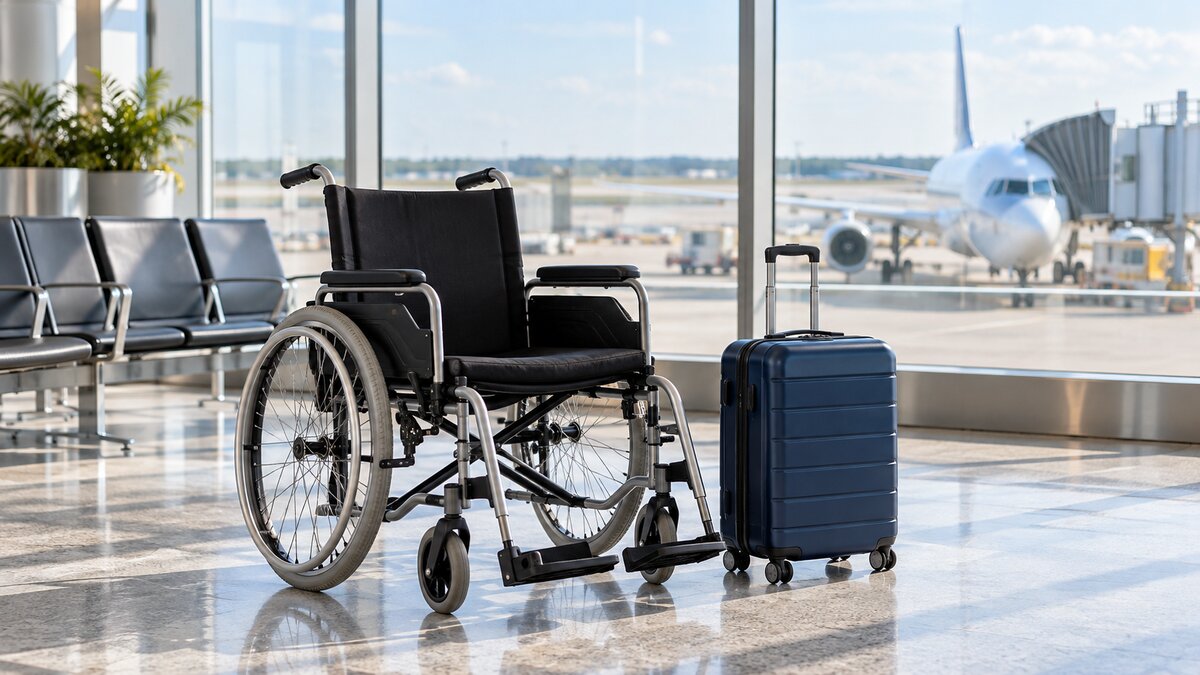
Scope and educational boundary: This guide helps older adults and family helpers organize a flight involving a wheelchair, scooter, or walker, including travel for a retirement move or family visit. It focuses on U.S. airline disability protections and screening at U.S. airports. It is educational information, not medical, legal, insurance, or equipment advice. Aircraft, itineraries, individual needs, and international rules differ. Confirm arrangements with each operating airline; ask the person's clinician about fitness to fly or care needs when those are uncertain.
A flight can be short while the travel day is long. The difficult parts may be the distance from the curb to the gate, getting into an aircraft seat, managing a bathroom visit, or finding the right vehicle after landing. A useful plan follows the person and the mobility device through every handoff.
Start with the person's travel needs
Ask the older adult what help they want and how they prefer staff to communicate. Describe practical tasks instead of writing a list of diagnoses:
- How far can the person comfortably walk, and can they manage stairs?
- Can they transfer into an aircraft seat, or do they need a boarding chair and trained assistance?
- What seating, positioning, or restroom needs must be discussed before choosing a flight?
- Will they need help understanding announcements, remembering instructions, eating, or managing personal care?
- Which equipment must stay available until boarding and immediately after landing?
Record preferences in a short travel note the passenger approves. If the trip is part of a permanent move, use YouRetire's interstate retirement move guide for the separate work of arranging care and benefits at the destination.
Separate three kinds of assistance
Airline help getting through the airport
The airline handles disability-related assistance through the terminal, boarding, connections, and arrival. DOT's wheelchair and guided-assistance guidance explains the process. A request in the reservation is useful, but the traveler still needs to identify themselves to airline staff on arrival. Ask where that first contact should happen.
TSA help with security screening
TSA Passenger Support Specialists assist with the screening process. TSA asks travelers to contact TSA Cares at least 72 hours before departure to request this help. The service does not provide airport wheelchairs, expedited screening, or an exemption from screening. Arrange airline assistance separately.
Personal care during the journey
Airlines are not required to provide feeding assistance, help inside the restroom, or medical services under 14 CFR 382.113. If the traveler needs those tasks, decide how they will be covered throughout the travel day. A relative's willingness to accompany someone does not establish that they can safely provide every kind of help.
Check the aircraft before choosing the itinerary
A flight listing rarely answers accessibility questions. The Airline Passengers with Disabilities Bill of Rights explains that airlines must provide information about the scheduled aircraft's relevant capabilities and limitations when requested. Ask about the actual flight, including any regional airline operating it.
- Will boarding use a jet bridge, stairs, a ramp, or a lift?
- What assistance is available for transferring to the seat?
- Does the aircraft have an accessible lavatory and an onboard wheelchair appropriate to the request?
- Can the mobility device fit through the cargo opening and be transported safely on this aircraft?
- How will assistance and equipment return work during a connection?
- What happens to these arrangements if the aircraft changes?
A nonstop flight removes a connection, but compare the whole journey: airport distances, departure time, personal-care arrangements, and the destination pickup. Leave room in the plan for waiting. Avoid choosing a tight connection on the assumption that assistance will make the distance irrelevant.
For a disability-related seat request, contact the airline when booking. Its process may involve advance timing or check-in requirements. DOT's seating accommodation guide explains that accommodations depend on the need and the airline's seating method; they do not automatically include an upgrade or an extra seat. Discuss an adjacent seat for a companion providing required personal assistance.
Make one request record for every flight
DOT's travel-planning guidance says passengers generally do not have to give advance notice for disability accommodations. Certain services can have requirements, including up to 48 hours' notice for transporting a powered wheelchair on an aircraft with fewer than 60 seats. Early planning is still useful. The TSA 72-hour request is a separate process, not a universal airline deadline.
Keep a compact record with:
- Operating airline, flight number, date, and connection airports.
- The assistance requested for departure, connection, and arrival.
- Seat needs, device details, and any airline forms or instructions.
- The airline's required arrival and check-in times.
- Confirmation or case number, contact channel, and unanswered questions.
Confirm the return journey too. After a schedule change, review assistance, seating, and device arrangements together. One family helper can maintain the record, while the passenger remains involved in decisions and has an accessible copy.
Prepare a mobility-device handoff
For a personal wheelchair or scooter, make a device sheet using the manufacturer's information. Include its model, dimensions, weight, battery type if applicable, and safe handling instructions. Identify removable parts and the correct way to place the device in transport or manual mode. DOT's assistive-device guide recommends sharing these details and checking aircraft fit.
Take clear photographs of the device's condition before travel. Keep copies of the instructions and photographs on a phone and an available backup. Identify a reachable contact on the device without displaying a home address, diagnosis, identification number, or complete itinerary.
Under DOT's Air Carrier Access Act summary, assistive devices do not count against carry-on piece limits. The required disability accommodations are provided without an additional fee. Storage still depends on space and safety requirements. Ask whether a folding walker or manual wheelchair can be stowed in the cabin; do not assume every device will fit. DOT's device guidance also explains that a bag containing ordinary personal items may count toward baggage limits.
Powered devices need a battery-specific conversation
The FAA's PackSafe wheelchair guidance distinguishes protected installed lithium-ion batteries, removable batteries, nonspillable or dry batteries, and spillable batteries. Their transport conditions differ. Contact the airline and manufacturer with the exact model and battery information before travel.
Ask who will handle any required removal, packaging, terminal protection, and reassembly, and where each battery will travel. Spare lithium-ion batteries must travel in the cabin, subject to the applicable limits and conditions. Do not substitute a generic phone-battery rule or improvise battery work at the gate. Confirm the earlier check-in requirement: DOT's wheelchair guidance says travelers with battery-powered wheelchairs must arrive one hour before the normal check-in time.
Pack for screening and an unexpected delay
DOT recommends carrying medication onboard because travelers can become separated from checked baggage. Keep essential supplies available, and have the pharmacist or clinician resolve questions about storage, dose timing, or a delay. YouRetire's medication-management guide can help organize the current list before packing.
At security, explain the person's ability to stand or walk before screening begins. TSA's disability and medical-condition guidance says travelers who have difficulty standing may ask for a chair or screening while seated in their wheelchair or scooter. Walkers and other mobility aids undergo screening; tell the officer if the device must be returned immediately after inspection.
Declare medically necessary liquids and related supplies before screening. TSA permits reasonable quantities of medically necessary liquids above the ordinary liquid limit, with inspection; this is not a blanket exemption for everything in a medical bag. The same TSA page explains medication and cooling-accessory procedures. Keep prescription and health details private, sharing what is needed through the official assistance process.
Use a boarding and arrival checklist
A simple introduction can prevent a vague request from becoming an incomplete arrangement: “I requested mobility assistance. I use this walker for short distances, need help reaching the gate, and need extra time to board. Please confirm how I will get my walker back after landing.” Adjust the script to the person's actual needs.
- At check-in: Confirm the recorded assistance, seating, device handling, and connection plan. Keep confirmation details available.
- At the gate: Identify the need for preboarding or transfer assistance. Tell staff what movement is safe and what help is needed; do not attempt an unfamiliar transfer to keep a line moving.
- Before handing over equipment: Confirm the return location and handling instructions. Keep removable essentials with the traveler when appropriate and permitted.
- After a gate change: Tell airline staff that assistance must move with the passenger. Update the family pickup contact if the itinerary changes.
- After landing: Check that the device, essential parts, and assistance are present before beginning the trip out of the airport.
DOT says travelers can retain a wheelchair or walker until the gate, and checked assistive devices should be returned promptly as close as possible to the aircraft door unless the passenger requests baggage claim. Confirm the arrangement with staff. An arrival pickup should also match the person's needs and the device's size. Use YouRetire's transportation-planning guide to organize a primary ride and backup.
If assistance or equipment is missing
Describe the immediate practical problem first: the person cannot safely transfer, the wheelchair has not arrived, or a necessary component is damaged. Ask for suitable assistance while the issue is addressed. Inspect returned equipment before using it; seek staff and qualified equipment help if its condition is uncertain.
For an unresolved airline disability issue, request the airline's Complaint Resolution Official, often called the CRO. DOT's problem-resolution guidance explains this role and the separate DOT complaint route. A screening concern belongs with a TSA supervisor or TSA's complaint process.
Report device damage promptly, preferably before leaving the airport, and request the claim procedure in writing. Keep photographs, device tags, flight details, names, receipts, and the case number. Ask about an appropriate temporary device and the repair process. Domestic and international liability rules differ; a claim's outcome cannot be determined from a general checklist.
Current-rule caution: As checked on October 22, 2026, DOT has paused enforcement of selected newer wheelchair-rule provisions. Its August 4, 2026 notice extends that discretion until April 30, 2027. DOT's assistive-device guidance explains that airlines still have responsibilities for devices they damage. Check current guidance and obtain claim-specific help instead of assuming an automatic reimbursement or a particular result.
An illustrative family plan
Rosa uses a folding walker at home and needs assistance over airport distances. She is flying to stay with her son while considering a move. With her permission, he records the assistance request, asks about boarding and seat access, and confirms where the walker will be returned. Rosa identifies her needs again at check-in.
They separately arrange TSA support, keep necessary medication accessible, and book a vehicle that can carry the walker and luggage. Her son saves the pickup provider's contact and a backup option. If the flight changes, he reviews the assistance requests and pickup together. This fictional example illustrates coordination; it does not predict an airline's service or establish anyone's medical suitability to fly.
Your next three actions
- Write the passenger-approved needs list and exact device details.
- Contact each operating airline about aircraft fit, assistance, seating, and timing; contact TSA separately for screening support.
- Complete the arrival plan, including personal care, equipment return, a suitable ride, and a backup contact.
Sources
Primary sources reviewed October 22, 2026. Recheck current airline instructions and official guidance before travel.
- DOT: Airline Passengers with Disabilities Bill of Rights
- DOT: About the Air Carrier Access Act
- DOT: General Travel Tips for Persons with Disabilities
- DOT: Wheelchair and Guided Assistance
- DOT: Seating Accommodation Interactive Guide
- DOT: Assistive Device — Stowage, Damage, and Delay
- FAA: PackSafe — Wheelchairs and Mobility Devices
- TSA: Passenger Support
- TSA: Disabilities and Medical Conditions
- 14 CFR 382.113: Services airlines are not required to provide onboard
- DOT: What to Do If You Have a Problem
- DOT: August 4, 2026 notification of enforcement discretion
Keep Reading
Related guides in Moving & Relocation
Trusted Help
Trusted Medicare coverage help
Hospital status, skilled nursing coverage, and post-discharge options often depend on formal Medicare rules, plan rules, and the exact date of service.
Use these links to verify eligibility, coverage, state rules, or local services before making a personal medical, legal, or financial decision.