
A practical family checklist for older adults who rely on powered medical devices, refrigerated medications, communication tools, or backup batteries during outages.
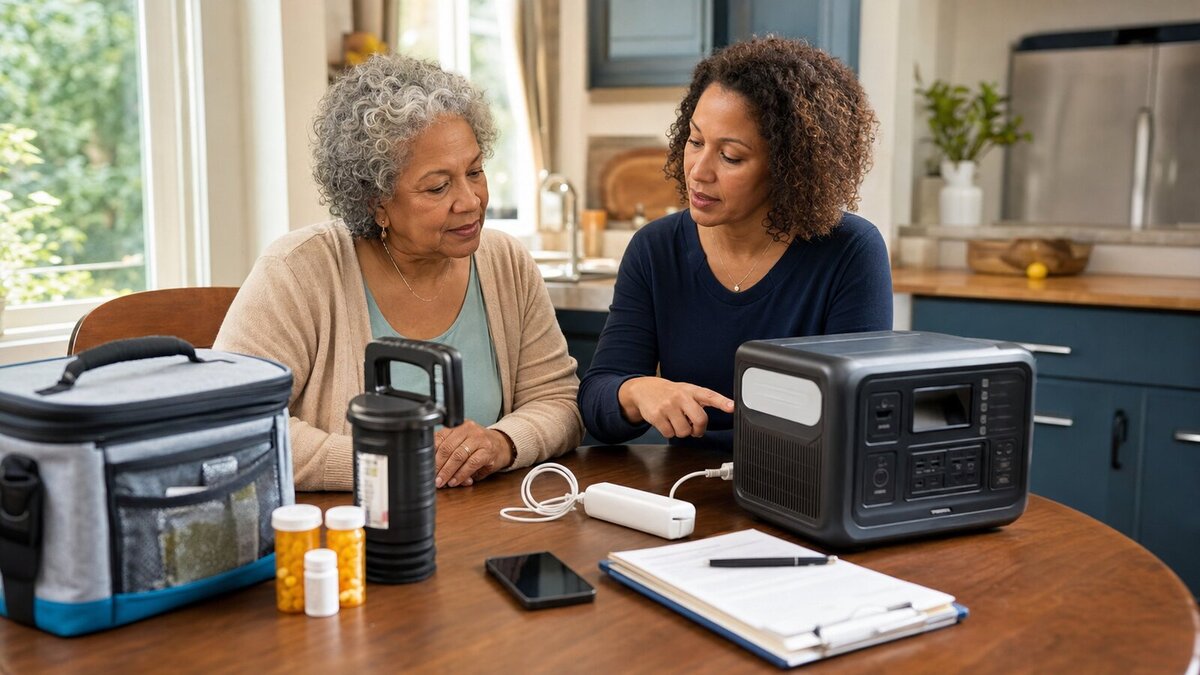
Power outages are more than an inconvenience when an older adult depends on electricity for oxygen equipment, a powered wheelchair, an adjustable bed, a medication refrigerator, a CPAP or BiPAP machine, an infusion pump, a phone used for emergency calls, or home internet that supports monitoring. A good plan does not need to be dramatic. It needs to be specific enough that a family member, neighbor, aide, or first responder can understand what must keep running, how long the backup power will last, and when it is time to leave for a safer place.
This guide is educational only and is not medical, legal, financial, or emergency-management advice. Use it as a family organizing tool, then confirm the device details with the clinician, home health agency, durable medical equipment supplier, pharmacist, local emergency manager, or utility provider that applies to your situation.
Start with a device-by-device inventory
The first mistake families make is treating "backup power" as one problem. It is really several problems. A phone may need a small power bank. A power recliner may only need a manual release plan. Oxygen equipment, suction equipment, dialysis-related supplies, powered mobility, or a medication pump may require a much more formal plan. The HHS emPOWER Map exists because many Medicare beneficiaries live independently while relying on electricity-dependent durable medical and assistive equipment or essential health care services. Families do not need to use a federal map to make a household plan, but the same idea applies: identify the people, devices, and services that become vulnerable when power fails.
Make a one-page inventory for each device or service. Include the device name, model, supplier, prescribing clinician, normal hours of use, backup battery type, estimated runtime, charging time, whether it can be safely powered by an external battery, and who to call if it alarms. Add the location of manuals, extra tubing, filters, distilled water, charging cords, adapters, and backup parts. If the device has settings, do not rely on memory; document what the clinician or supplier says is safe for a caregiver to verify.
Ask better questions before the outage
A plan is stronger when families ask concrete questions. For each power-dependent item, ask the clinician or supplier:
- How long can this device safely run on its internal battery?
- Can it be connected to a portable power station, external battery, vehicle inverter, or generator?
- Does it require pure sine wave power or a specific wattage?
- What alarms mean "switch power now," "call the supplier," or "call 911"?
- What should we do if the device stops and cannot be restarted?
- Which supplies should be kept for a three-day disruption?
- What information should travel with the person if evacuation is needed?
The FDA's home-use medical device guidance tells manufacturers to think about backup power options and emergency contacts for devices that require AC power. That does not mean every device has the same backup approach. The safest answer comes from the specific device manual, supplier, and care team.
Calculate backup runtime in real life, not just on the box
Portable power stations and backup batteries are often advertised with large numbers that are hard to translate into care time. Families need a simpler working estimate: how many watts the device uses, how many hours it must run, and whether the battery has enough usable capacity after normal efficiency losses.
For example, if a device uses 60 watts and needs to run for 8 hours overnight, the rough need is 480 watt-hours before losses. A 500 watt-hour battery may not actually deliver a full 500 watt-hours to the device, especially through an AC outlet. A family might decide that one battery is not enough, or that the plan should include a shorter use schedule approved by the clinician, a second battery, or a destination with reliable power.
Do not guess for life-supporting equipment. Some devices have startup surges, alarms, humidity settings, compressors, or chargers that change the power draw. Some devices should not be plugged into an untested inverter. When the stakes are high, ask the supplier to help match the backup source to the device.
Build three layers of backup
Layer one is immediate power for the first minutes or hours. This may include internal device batteries, charged phone power banks, flashlights, battery lanterns, spare batteries, and a small portable power station. Label chargers and keep them in one place. Set calendar reminders to recharge backup batteries, because a battery stored empty is not a plan.
Layer two is household continuity for a longer outage. This might include a larger portable power station, extra medical-device batteries, a generator that is installed and used safely, a vehicle charging plan, or a neighbor's outlet only if the route and weather are safe. If a generator is part of the plan, carbon monoxide safety becomes central. The CDC warns that generators and other fuel-burning equipment can create carbon monoxide, and the CDC's power outage guidance says generators should not be used inside a home, basement, or garage. The CDC's carbon monoxide basics also recommend battery-operated or battery-backup CO detectors near sleeping areas.
Layer three is relocation. A plan should name where the older adult can go if power is expected to be out longer than the safe backup window: a relative's home, a community shelter with power, a medical respite site, a hospital if directed by a clinician, or another facility arranged through local emergency management. Ready.gov's power outage guidance encourages households to plan ahead for powered medical devices and refrigerated medicines, and its preparedness guidance for people with disabilities includes planning for battery-operated medical or assistive technology.
Plan for refrigerated medications and supplies
Medications that require refrigeration need their own plan. Do not assume that a refrigerator, cooler, or ice pack keeps every medicine in the required temperature range. Ask the pharmacist what temperature range matters, how long the medicine can safely be outside that range, how to pack it for travel, and what to do if you are unsure whether it stayed cold enough.
The CDC's power outage guidance notes that refrigerated drugs may need to be replaced after a longer outage unless the label says otherwise, and that life-dependent refrigerated medication should be used only until a new supply is available if it has been at room temperature. Families should treat that as a prompt to call the pharmacist, prescriber, or emergency line rather than trying to make a medication-safety judgment alone.
Keep a small medication travel kit ready: current medication list, pharmacy phone number, prescriber phone number, insurance cards, ice packs, thermometer if recommended, labeled cooler, and written instructions for what must stay cold. If an evacuation is possible, keep the kit reachable instead of buried in a closet.
Make communication work when internet and cordless phones fail
Many homes lose Wi-Fi, internet calling, cordless phone service, and medical portal access when the power goes out. The communication plan should not depend on one device. Keep a charged cell phone, a wall charger, a car charger, a power bank, important numbers on paper, and a neighbor contact who can physically check in if calls fail.
If the older adult uses a medical alert system, ask the company how the system works during an outage. Does the base station have a backup battery? Does it use cellular service or home internet? How long does the battery last? What happens if the person presses the button but the base unit has no power? Write down the answer in plain language.
Families who live far away should assign check-in roles before storm season. For example: one adult child watches outage maps and local alerts, one calls the older adult, one calls the neighbor or building manager if contact is lost, and one keeps the medication and device list updated. The goal is to avoid five people assuming someone else called.
Register, but do not rely on registration alone
Some utilities, cities, counties, and emergency-management offices offer medical baseline, life-support, access and functional needs, or priority-notification programs. These programs may help with warnings, account notes, or planning, but they usually do not guarantee uninterrupted power or immediate restoration. Treat registration as one layer, not the whole plan.
Call the electric utility and ask what programs exist for customers who use electricity-dependent medical equipment. Ask whether a clinician form is required, how often it must be renewed, whether the household can receive outage alerts by phone or text, and what the utility does and does not promise. Then call local emergency management or 211, where available, to ask about sheltering, transportation, and special-needs registry options.
The HHS emPOWER Map helps public health and emergency partners estimate electricity-dependent Medicare populations by geography and plan resources such as shelters, outreach, and restoration support. Families can use the same mindset locally: do not wait for a disaster to learn who in the community handles medical-power needs.
Know when staying home is no longer safe
The most important decision point is not "Can we make it a little longer?" It is "What sign tells us to leave or call for help?" Write those triggers down. Examples may include:
- The primary medical device has less than two hours of battery remaining and no confirmed way to recharge it.
- The home is too hot or too cold for the older adult's health condition.
- Refrigerated medication can no longer be kept in the recommended range.
- Cell service is failing and the person cannot safely be alone.
- A generator cannot be used safely outside and away from openings.
- The person depends on powered mobility and cannot transfer, toilet, or leave the home safely.
- A clinician, home health nurse, supplier, or emergency official says relocation is needed.
For infusion pumps, the FDA recommends that people using pumps at home work with a home health nurse on a backup plan, know whether the plan includes calling 911, and know how to access backup power. Similar thinking applies to any device where a delay could cause harm: define the escalation step before the battery is nearly empty.
Pack a power-outage care folder
A useful care folder is short enough to use under stress. Keep one printed copy near the supplies and one digital copy with the main caregiver. Include:
- Device inventory with model numbers, settings to verify, battery runtime, and supplier phone numbers.
- Medication list, refrigerated medication instructions, pharmacy number, and allergies.
- Emergency contacts, neighbors, building manager, home health agency, and primary clinician.
- Insurance cards, Medicare or Medicaid information, and photo ID copies if appropriate.
- Utility account number and medical-notification program details.
- Transportation plan, including wheelchair-accessible options if needed.
- Evacuation destination choices and what supplies must go with the person.
Review the folder after any hospitalization, new diagnosis, equipment change, medication change, move, or caregiver change. A power plan from last year may be wrong if the oxygen prescription changed, the battery aged, or the person now needs help transferring.
Run a calm practice test
A short practice test can reveal problems while everyone is safe. Choose a daytime hour. Confirm the older adult is comfortable, then walk through the plan without actually creating danger. Find the battery, connect the charger if the supplier says that is appropriate, read the alarm instructions, locate the flashlight, check the phone bank, open the care folder, and practice calling the neighbor or backup caregiver. If the device is medically important, ask the supplier or clinician how to test the plan safely before unplugging anything.
After the test, write down what failed. Maybe the flashlight batteries were dead, the power station cord was missing, the family could not find the oxygen supplier number, or the medication cooler was too small. Those are good discoveries when the lights are still on.
Family next steps
- List every device, medication, and communication tool that depends on electricity.
- Call the device supplier, clinician, pharmacist, and utility with specific backup-power questions.
- Set a realistic safe-at-home window for each device and for the whole household.
- Choose backup locations before the next storm, heat wave, wildfire smoke event, or winter outage.
- Create a printed care folder and assign family check-in roles.
- Practice the plan once, then fix the gaps.
Families do not need a perfect emergency system. They need a written, tested plan that says what must keep running, who is responsible, and when to get help. That clarity can turn a frightening outage into a managed event with fewer rushed decisions.
Sources
- Ready.gov: Power Outages
- Ready.gov: People with Disabilities
- HHS emPOWER Map
- CDC: What to Do to Protect Yourself During a Power Outage
- CDC: Carbon Monoxide Poisoning Basics
- FDA: Design Considerations for Devices Intended for Home Use
- FDA: Infusion Pump Risk Reduction Strategies for Patients Using Infusion Pumps at Home
Keep Reading
Related guides in Senior Safety
Trusted Help
Trusted Medicare coverage help
Hospital status, skilled nursing coverage, and post-discharge options often depend on formal Medicare rules, plan rules, and the exact date of service.
Use these links to verify eligibility, coverage, state rules, or local services before making a personal medical, legal, or financial decision.